
Ivy Club after 1899
The transition to more formal clubhouses that began at the turn of the century directly mirrors Princeton's institutional rejuvenation. For much of 19th century, the College of New Jersey had been regarded as a second- tier institution, but by the time of the Sesquicentennial in 1896, Princeton's national reputation had improved significantly. This reputation continued to grow during the presidency of Woodrow Wilson (1902- 10).
As a result, the student body at the turn of the century was comparatively more affluent than at any time in the university's history. Backed by powerful and prominent alumni, these students erected clubhouses that express in architectural terms the increasing clout, prestige, and resources of the clubs and their members. This second period in the evolution of Prospect Avenue saw the eating clubs move toward significantly more urbane and elaborate structures.
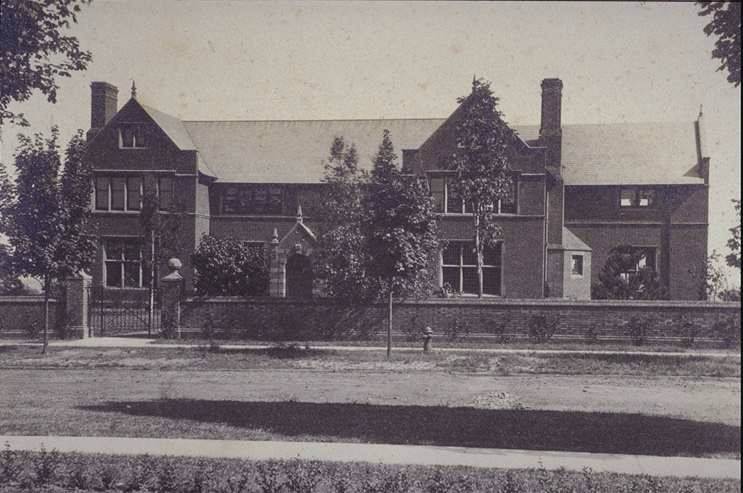
Princeton University. Property of the Trustees of Princeton University.
Source: Princeton University Archives, Mudd Library, Grounds & Buildings, Box 42

Ivy Club built the first resolutely formal structure on Prospect Avenue in 1899- 1900. Putatively modeled on the Peacock Inn in Derbyshire, Ivy was designed by Cope and Stewardson, the same firm that designed Blair Tower on the campus and the leading American interpreter of the increasingly popular Collegiate Gothic style. Balancing the formality of the front elevation, however, is Ivy's more relaxed rear elevation, which looks out to the south over the club garden.
Cope and Stewardson's elegant Ivy clubhouse immediately set a new standard of graciousness and refinement for the clubs. And this new building also set in motion a flurry of other changes on Prospect.