Princeton University. Property of the Trustees of Princeton University.
From an architectural history point of view, however, the post-Revolutionary period is barren, and much of the record concerns repairs. The rebuilding took a long time. At the turn of 19th century, the Trustees were still seeking war reparations from the government.
Finally, in 1801, they received: 1,800 pounds (about $4,800). In April of that year, the Trustees decided to use this money to repair Nassau Hall and acquire new "philosophical equipment" (as scientific apparatus was then called). The Trustees specifically appropriated $700 to repair the rooms in Nassau Hall and to raise the floors "by about a foot" in order to make the rooms "dry, airy, and wholesome."
At the same meeting, Enos Kelsey, the college treasurer, reported that $2,273.21 had been spent constructing the third permanent structure at the college, a house "for the accommodation of a Professor of the College." Commissioned in 1799 as a residence for John Maclean Sr., this house
faced onto Nassau Street and served as a pendant to the President's House. During the tenancy of Philip Lindsley, Ashbel Green's Vice President, it became known as the Vice President's House. The house was next occupied by John Maclean Jr. It was demolished or removed in the early 1870s.
In its own small way, this modest new structure represented an improvement in the College's institutional health. Upon Witherspoon's death in 1795, Samuel Stanhope Smith, class of 1769, had succeeded his father-in-law as President, and under his leadership the enrollment had rebounded. With a refurbished Nassau Hall, the College could look forward to the new century with justified optimism.
Aside from the Steward's House, built behind and slightly to the east of Nassau Hall in 1762, the existence of other buildings on the campus during the period 1756 to 1803 remains conjectural. President Burr owned a farmhouse and its adjacent land near where Dillon Gymnasium stands today. He may have added to the structure during his short residency at Princeton. The Trustees Minutes for 24 September 1760 record the speedy removal of the "President's Barn."
The other building project was of an equally prosaic nature. An anonymous account of Princeton's history suggests that the third building on campus was a firehouse, constructed in 1757. The Trustees Minutes do not support this proposition, although there was mention, in 1765, of leather buckets in an "enginehouse." This enginehouse would appear to have been replaced by a larger structure (location also unknown) in 1766. These preparations, however, would soon prove insufficient. In 1802, as the College of New Jersey appeared to flourish for the first time in a long while, came the great fire.


From an architectural history point of view, however, the post-Revolutionary period is barren, and much of the record concerns repairs. The rebuilding took a long time. At the turn of 19th century, the Trustees were still seeking war reparations from the government.
Finally, in 1801, they received: 1,800 pounds (about $4,800). In April of that year, the Trustees decided to use this money to repair Nassau Hall and acquire new "philosophical equipment" (as scientific apparatus was then called). The Trustees specifically appropriated $700 to repair the rooms in Nassau Hall and to raise the floors "by about a foot" in order to make the rooms "dry, airy, and wholesome."
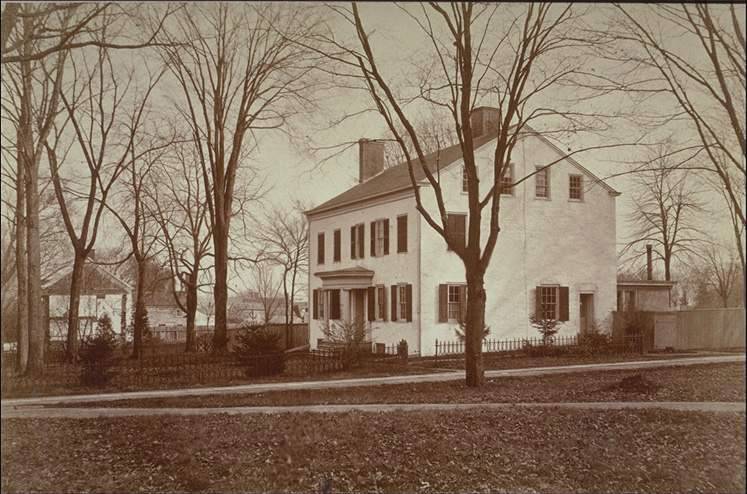
At the same meeting, Enos Kelsey, the college treasurer, reported that $2,273.21 had been spent constructing the third permanent structure at the college, a house "for the accommodation of a Professor of the College." Commissioned in 1799 as a residence for John Maclean Sr., this house faced onto Nassau Street and served as a pendant to the President's House. During the tenancy of Philip Lindsley, Ashbel Green's Vice President, it became known as the Vice President's House. The house was next occupied by John Maclean Jr. It was demolished or removed in the early 1870s.
In its own small way, this modest new structure represented an improvement in the College's institutional health. Upon Witherspoon's death in 1795, Samuel Stanhope Smith, class of 1769, had succeeded his father-in-law as President, and under his leadership the enrollment had rebounded. With a refurbished Nassau Hall, the College could look forward to the new century with justified optimism.
Aside from the Steward's House, built behind and slightly to the east of Nassau Hall in 1762, the existence of other buildings on the campus during the period 1756 to 1803 remains conjectural. President Burr owned a farmhouse and its adjacent land near where Dillon Gymnasium stands today. He may have added to the structure during his short residency at Princeton. The Trustees Minutes for 24 September 1760 record the speedy removal of the "President's Barn."
The other building project was of an equally prosaic nature. An anonymous account of Princeton's history suggests that the third building on campus was a firehouse, constructed in 1757. The Trustees Minutes do not support this proposition, although there was mention, in 1765, of leather buckets in an "enginehouse." This enginehouse would appear to have been replaced by a larger structure (location also unknown) in 1766. These preparations, however, would soon prove insufficient. In 1802, as the College of New Jersey appeared to flourish for the first time in a long while, came the great fire.