
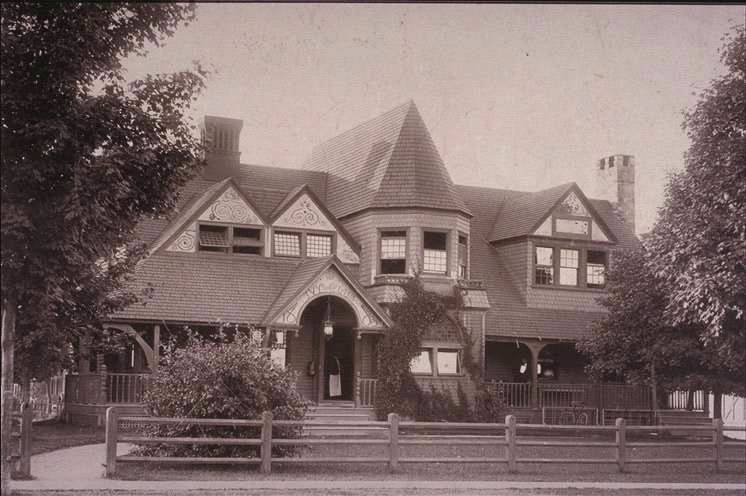
Ivy Club circa 1890
Prospect Avenue's architectural history spans only the short, frenetic period at the turn of the century when the clubhouses that stand today were actually designed and built. Indeed, one of the most extraordinary aspects of the entire club phenomenon is the speed at which the clubs formed and raised their own buildings. By the time this boom in club construction ended, Princeton's 19 eating clubs would occupy dozens of different buildings in a bewildering array of moves, renovations, and new facilities.
Keeping track of the various incarnations of the clubs as they jitterbugged around Prospect Avenue can be confusing. To provide some context for this intricate dance -- and to help make sense of the architectural evolution of Prospect Avenue as a whole -- it is possible to divide the development of the clubs into three loose phases. Although it wasn't apparent at the time, each of these phases is marked by corresponding shifts in club architecture.
First, there was the period of creation, lasting from the late 1870s roughly through the turn of the century. This era saw the first clubs take root at Princeton (go to Origins of the Club System ) and also saw the construction of the first custom- built clubhouses on Prospect Avenue.
In keeping with the times, the overall style of these early clubs was in line with the domestic architecture of the period -- informal, suggestive of the idyllic, pastoral life deemed appropriate for young gentlemen of the late 19th century.
Princeton University. Property of the Trustees of Princeton University.
Source: Princeton University Archives, Mudd Library, Grounds \& Buildings, Box 34

Ivy's first building on Prospect Avenue...