
Pyne Hall
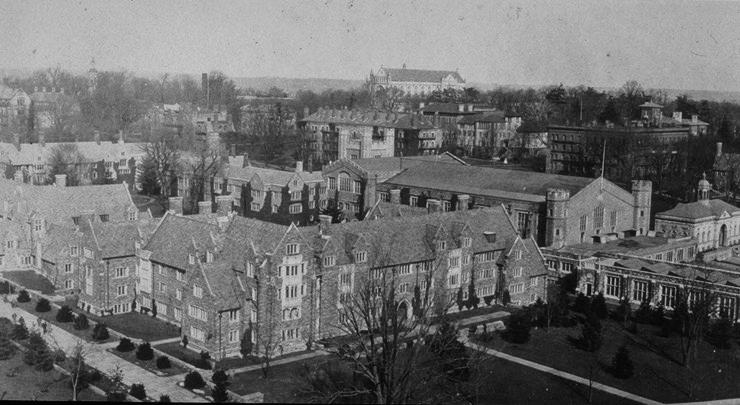
Princeton University. Property of the Trustees of Princeton University.
Source: Princeton University Archives, Mudd Library, Grounds & Buildings, SP 6
Princeton University. Property of the Trustees of Princeton University.
Source: Princeton University Archives, Mudd Library, Grounds & Buildings, SP 6

In 1921, with students returning after serving in World War I and the enrollment booming, Princeton could accommodate barely half of its student body in on-campus housing. The ideal of the Oxbridge residential university, extolled by Wilson, West, and such Trustees as Moses Taylor Pyne, still eluded Princeton (despite the surge in dormitory construction that had begun in 1896 with the erection of Blair Hall).
With the war over, President Hibben turned immediately to address the urgent need for dormitories. In the decade beginning in 1921, Princeton constructed nine new dormitories, all in the Collegiate Gothic style. This flurry of building added more than 500 rooms for undergraduates and brought the percentage of students living off-campus to less than fifteen percent.
Most of the dormitories from this period were clustered on the flat ground between Blair Hall and University Place, the area of campus now known as the 'Junior Slums'. This land had been the site of the Pennsylvania Railroad station, but, in 1918, the station and tracks had been torn up and the Dinky station moved south to its current location [Curator's note: The Dinky station was moved further south in 2014].
The university had big plans for this large parcel of land. As early as 1908, Ralph Adams Cram had targeted this area for future dormitory development and following the war, the university began to implement his plans.
The first and largest of the post-war dormitories was Pyne, a four-story, U-shaped building with room for 177 students. Completed in 1922, Pyne would be the least ornamented of the group, the need for speedy completion outweighing the need for exterior detailing. According to Cram's master plan, Pyne --the southernmost of the proposed dormitory group -- was built first, with later structures progressing north toward Blair Arch.