
View from the north, circa 1760
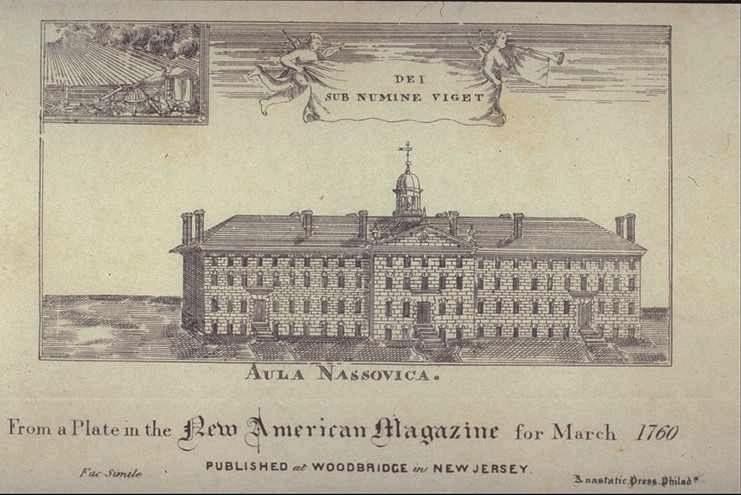
Princeton University. Property of the Trustees of Princeton University.
Source: Illustration in New American Magazine, 1760. (John T. Miller )
Princeton University. Property of the Trustees of Princeton University.
Source: Illustration in New American Magazine, 1760. (John T. Miller )

Nassau Hall was, at the time of its completion in 1756, the largest stone building in the colonies. It was much admired and provided the inspiration for other college buildings, notably Hollis Hall at Harvard, University Hall at Brown, Dartmouth Hall at Dartmouth, and Queens Hall at Rutgers. "We do everything in the plainest and cheapest manner, as far as is consistent with Decency and Convenience, having no superfluous Ornaments," President Aaron Burr, Sr., wrote a benefactor in Scotland, and this was the guiding principle in the design of Nassau Hall. The trustee minutes mention a plan by William Worth, a local stonemason, and another plan by Dr. William Shippen of Philadelphia and Robert Smith, a carpenter-architect who later designed Carpenter's Hall in Philadelphia. No doubt Dr. Shippen contributed to the design of the building, as William Worth may have done in addition to the considerable contribution he made to its execution, but the major responsibility must have been Smith's, since an account of the College published by the trustees in 1765 declared that Nassau Hall was "designed and executed by that approved architect, Mr. Robert Smith, of Philadelphia."
The trustees originally voted that "the College be built of Brick if good Brick can be made at Princeton and if sand can be got reasonably cheap," but they later changed their plans and "the College" was built of a light brown sandstone from a nearby quarry. That it was good stone and that it was well and truly laid by William Worth, the mason, is substantiated by the fact that the exterior walls, which were twenty-six inches thick, withstood the extraordinary shocks and strains the building had to endure: the depredations it suffered during two years of military occupation in the Revolution, devastating fires in 1802 and 1855, and disturbances of rebellious students, who on one occasion exploded a hollow log charged with two pounds of gunpowder inside the main entrance, cracking the adjacent interior walls from top to bottom.
It took two years to erect this building and even before it was completed the trustees voted to name it for the governor of the Province, Jonathan Belcher, who staunchly befriended the College in many ways. "Let BELCHER HALL proclaim your beneficent acts . . . to the latest ages," they wrote the governor, but, "with a rare modesty," as President Maclean later noted, the governor declined the honor, and at his suggestion the building was named Nassau Hall in memory of "the Glorious King William the Third who was a Branch of the Illustrious House of Nassau."
Early Nassau Hall in the Campus Evolution Narrative
Source: Leitch p. 328ff