
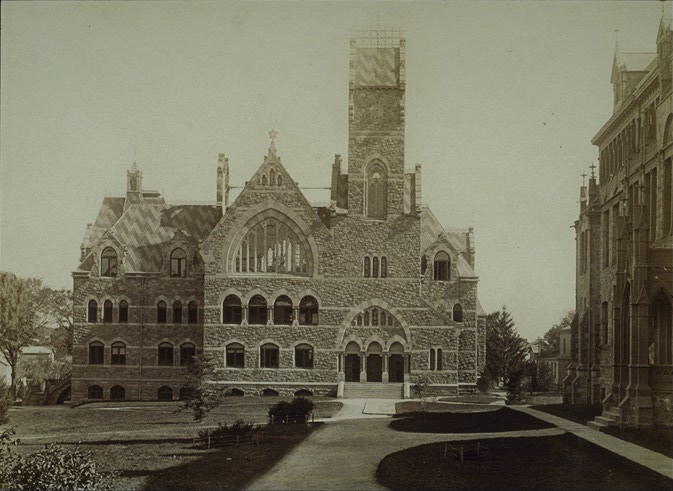
John C. Green School of Science, viewed from the west with Dickinson Hall at right (photo circa 1876-80)
Princeton University. Property of the Trustees of Princeton University.
Source: Princeton University Archives, Mudd Library, Grounds & Buildings, Box 63

With the library underway, McCosh turned to the urgent task of upgrading the College's scientific laboratories and equipment. Since the departure of Joseph Henry in 1848, the College had not modernized its facilities or kept pace with the new advances in fields such as biology, chemistry, and physics. Students studied these areas theoretically, but there was very little space in which they could perform experiments.
As McCosh put it, "lectures without experiments performed by the students may widen the mind, but they will not make chemists or give accurate scientific knowledge."
To address this issue, McCosh and John C. Green conceived of the John C. Green School of Science. Completed in 1874, this building contained lecture rooms, laboratories, and a museum, and it represented a tremendous step forward in the teaching of the sciences at Princeton. Not only did this facility give the College scientific facilities (and new equipment) on par with its peers, but the donor also endowed $250,000 for science professorships.
The School of Science was designed by Potter and was executed in the High Victorian Gothic style. Distinguished by a 140-foot-tall clock tower and the large arched window of the museum, it was prominently located across from the new library. The School of Science thus formed with Dickinson and Chancellor Green a quadrangle bounded by Nassau Street to the north.
Thus the focal point of the campus had shifted from the front and back campus of Nassau Hall to this new grouping of High Victorian Gothic structures and the enclosed lawn.