Princeton University. Property of the Trustees of Princeton University.
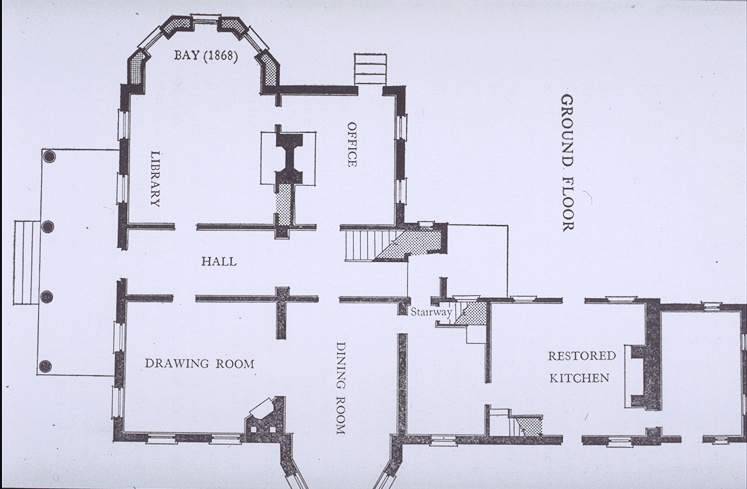
Smith designed the house to harmonize with Nassau Hall in its symmetry and original buff color. The one-story kitchen at the rear of the house was originally a separate building, but it is maintained that in the first of many renovations to this structure, President Burr had a passageway constructed that would enable his slave, Caesar (bought in 1755 for 80 pounds), to bear hot food from the big cooking fireplace in the kitchen to the dining room inside the house. The kitchen was also placed so that it could serve the residents of Nassau Hall in need.
Burr lived in the house for only a year. He died in 1757 at the age of 41, with his widow, Esther, living only a year longer before dying from smallpox. They left two young children, including a two-year-old boy named Aaron Jr.
After Burr's death, the College struggled through a rapid succession of presidents. The third president, Jonathan Edwards , died after only a year in office; it was in the President's House that he received the smallpox inoculation that killed him. He was succeeded by Samuel Davies , who served from 1759 to 1761. The fifth president, Samuel Finley, was at Princeton only a few years before passing away in 1766. Finley left the most notable mark on the house, reputedly planting the two large sycamore trees that still stand in front. These are the so-called "Stamp Act" trees, marking the year they were planted.
After 1878 the building served as the Dean's House (and was known by this name) until 1968, when it was renamed in honor of Princeton's 10th president and turned over to administrative uses. The house has since been designated a National Historic Landmark.
Anecdotes and legends of President's House may be found here


Smith designed the house to harmonize with Nassau Hall in its symmetry and original buff color. The one-story kitchen at the rear of the house was originally a separate building, but it is maintained that in the first of many renovations to this structure, President Burr had a passageway constructed that would enable his slave, Caesar (bought in 1755 for 80 pounds), to bear hot food from the big cooking fireplace in the kitchen to the dining room inside the house. The kitchen was also placed so that it could serve the residents of Nassau Hall in need.
Burr lived in the house for only a year. He died in 1757 at the age of 41, with his widow, Esther, living only a year longer before dying from smallpox. They left two young children, including a two-year-old boy named Aaron Jr.
After Burr's death, the College struggled through a rapid succession of presidents. The third president, Jonathan Edwards , died after only a year in office; it was in the President's House that he received the smallpox inoculation that killed him. He was succeeded by Samuel Davies , who served from 1759 to 1761. The fifth president, Samuel Finley, was at Princeton only a few years before passing away in 1766. Finley left the most notable mark on the house, reputedly planting the two large sycamore trees that still stand in front. These are the so-called "Stamp Act" trees, marking the year they were planted.
After 1878 the building served as the Dean's House (and was known by this name) until 1968, when it was renamed in honor of Princeton's 10th president and turned over to administrative uses. The house has since been designated a National Historic Landmark.
Anecdotes and legends of President's House may be found here