
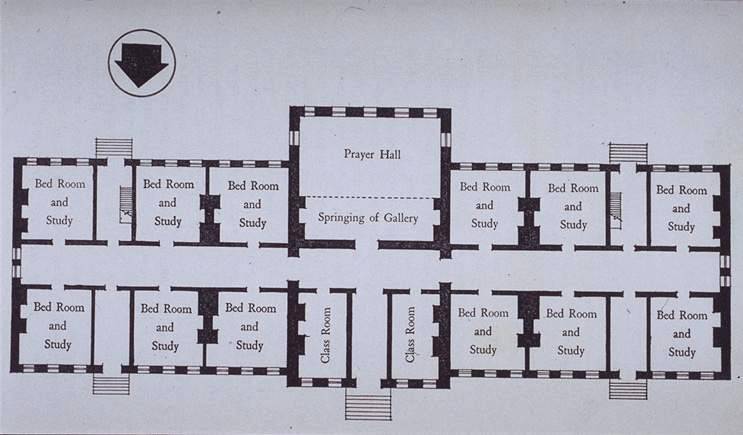
Plan of first floor 1756 (Savage reconstruction)
Princeton University. Property of the Trustees of Princeton University.
Souce: Savage, Nassau Hall, 1756-1956, p.17
Princeton University. Property of the Trustees of Princeton University.
Souce: Savage, Nassau Hall, 1756-1956, p.17

Smith's Nassau Hall had three stories and a basement. It was about 176 feet long and 54 feet wide at the ends, with a central element projecting about four feet in front and about twelve feet in back. Over the center of the hip roof was a modest cupola. There were three entrances at the front of the building and two at the back.
On each of the three floors, a central corridor ran the whole length of the building east to west and all the rooms opened on these corridors. There was a two-story prayer hall, 32 by 40 feet, at the rear of the central projection, and a library on the second floor above the main entrance hall. On the three main floors were 42 chambers, some used for classes and for tutors, most of them for student lodging. In the basement were the kitchen, dining room, steward's quarters, and, after 1762, additional rooms for students.
Nassau Hall suffered severely in the Revolution. British and American troops quartered there at different times plundered the library, ruined the organ in the prayer hall, and used furniture and woodwork for fuel. In the Battle of Princeton, Nassau Hall changed hands three times and once when the British were in possession, felt the effects of Washington's artillery. One American cannonball came through a window of the prayer hall, destroying a portrait of George II, and another hit the south wall of the west wing and left a scar that is visible today.
Funds being in short supply, recovery was slow; yet by 1783 Nassau Hall was ready to serve as the national capital. For four months that year, July through October, the Continental Congress met in the library on the second floor, using the prayer hall for state occasions. Here Congress congratulated George Washington on his successful termination of the war, received the news of the signing of the definitive treaty of peace with Great Britain, and welcomed the first foreign minister -- from the Netherlands -- accredited to the United States.
Source: Leitch p. 328ff