Princeton University. Property of the Trustees of Princeton University.
Source: Princeton University
...when it was remodeled by Messrs. Day and Klauder as the present Faculty Room. The cost was defrayed by a bequest from Augustus S. Van Wickle, a descendant of Nathaniel FitzRandolph, who gave the land on which Nassau Hall was built; Van Wickle's bequest also provided the FitzRandolph Gateway. When the Faculty Room was formally opened on November 2, 1906, President Wilson, in accepting the bequest on behalf of the trustees, said "there could be no more appropriate gift from a descendant of Nathaniel FitzRandolph than one which touched with added beauty his original gift."
Peale's portrait of Washington still hangs in the place of honor in this room along with replacements of the portrait of King George II, damaged in the Battle of Princeton, and of Governor Belcher, lost probably in one of the fires. Now they are accompanied by a portrait of William III, Prince of Nassau, as well as portraits of all of Princeton's presidents and some of its illustrious early graduates.

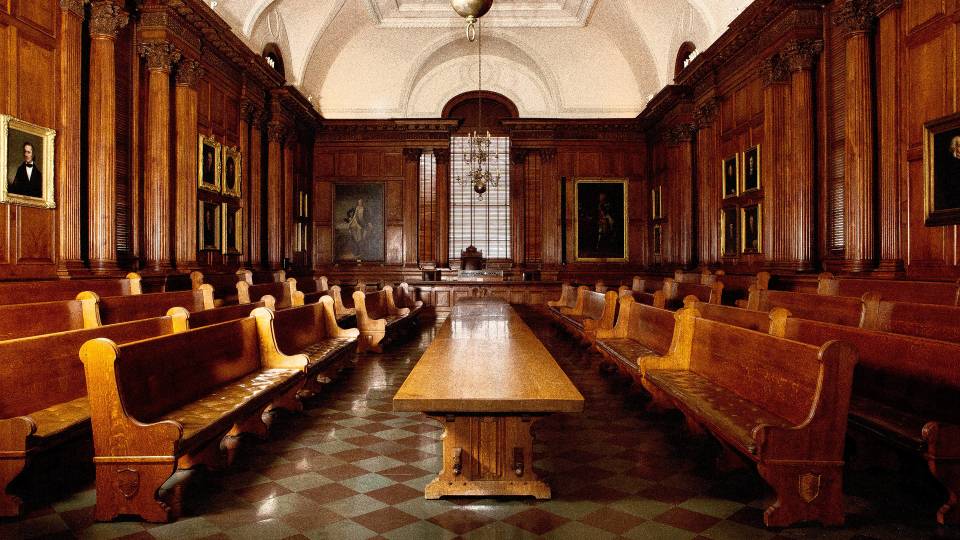

...when it was remodeled by Messrs. Day and Klauder as the present Faculty Room. The cost was defrayed by a bequest from Augustus S. Van Wickle, a descendant of Nathaniel FitzRandolph, who gave the land on which Nassau Hall was built; Van Wickle's bequest also provided the FitzRandolph Gateway. When the Faculty Room was formally opened on November 2, 1906, President Wilson, in accepting the bequest on behalf of the trustees, said "there could be no more appropriate gift from a descendant of Nathaniel FitzRandolph than one which touched with added beauty his original gift."
Peale's portrait of Washington still hangs in the place of honor in this room along with replacements of the portrait of King George II, damaged in the Battle of Princeton, and of Governor Belcher, lost probably in one of the fires. Now they are accompanied by a portrait of William III, Prince of Nassau, as well as portraits of all of Princeton's presidents and some of its illustrious early graduates.
Source: Leitch p. 328ff