
View from northeast (late 1890's photo?)
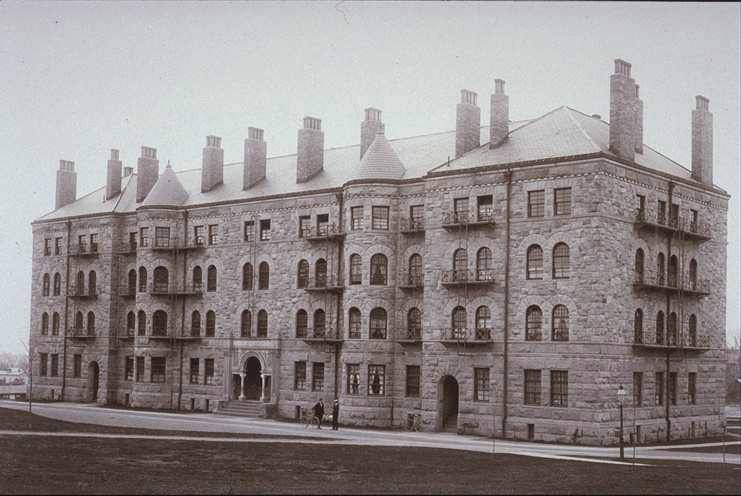
Princeton University. Property of the Trustees of Princeton University.
Source: Princeton University Archives, Mudd Library, Grounds & Buildings, Box 31
Princeton University. Property of the Trustees of Princeton University.
Source: Princeton University Archives, Mudd Library, Grounds & Buildings, Box 31

Although the enrollment of the College tripled during James McCosh's 20 years as President, this increase occurred in two distinct waves: the first during the early- and mid-1870s and the second during the late 1880s. It was the second wave of students that precipitated the construction of Albert B. Dod Hall, the fourth dormitory built (or conceived) during McCosh's administration.
By 1888, it had been almost a decade since the construction of Edwards Hall, the "poor man's dormitory," and by the fall of that year, half the freshmen class had lodgings in town. Accordingly, the College decided to construct a new dormitory. In early 1889, the Trustees awarded the contract to the New York architect, A. Page Brown. Brown was instructed to design a five-story dormitory with three entries that would be located diagonally to the southeast of Edwards. The working title of the new building was Brown Hall, a name chosen not to honor the architect but to honor the donor, Mrs. David B. Brown.
A. Page Brown was the logical choice to design the new dormitory. His recent commissions at Princeton included the Museum of Historic Art, the Class of 1877 Biological Laboratory, and President McCosh's retirement home on Prospect Avenue. But Brown moved to San Francisco and never completed his plan for Brown Hall. Instead, by the fall of 1889, Boston architect John Lyman Faxon had taken over the job and construction had already begun.