Princeton University. Property of the Trustees of Princeton University.
Source: Bric-a-Brac, 1938, p.197
The last club built, Arbor Inn, is an unexceptional design, but nonetheless laden with visual symbolism. Built in 1935, this mock French chateau bears no traces of the dominant styles of Prospect Avenue -- Colonial, Georgian, and Gothic. Although the club system was more entrenched than ever by the mid- 30s, the world was changing and the design of Arbor Inn is significant in its adoption of a new period and a different style. By consciously rejecting old models, Arbor represents the culmination of the move away from highly formal club designs.
Thus the oldest and newest club buildings -- Tiger Inn and Arbor Inn -- form odd stylistic bookends around the mostly classical architectural development of Prospect Avenue. Tiger represents the only survivor of the clubs' first architectural phase, that less formal period that resonated of 19th-century resort life. Arbor Inn, modeled on a simple French country chateau, brings the evolution of the clubs back full circle to their modest origins. It marks the conclusion of the trend that started as far back as 1909, when Campus Club backed off from the challenge of matching the opulence of its peers.
In this regard, Arbor's rapid demise -- the club folded in 1939, after only four years in its new building -- seems somehow fitting. After all, the eating clubs started as loose- knit, short- lived associations, and their early choice of architectural styles reflected their informal character. The distinctly informal design (and questionable institutional vitality) of Arbor a half- century later harkens back to those uncertain early days. It is as if the Georgian splendor of Cottage Club had never been.
This cycle serves once again to remind us of the brevity and singularity of the club phenomenon. By the 1930s, the chance convergence of time, money, ambition, and architecture that created the Prospect Avenue of today had vanished under the economic and social pressures of the Depression. The great era of club construction was over, never to return.

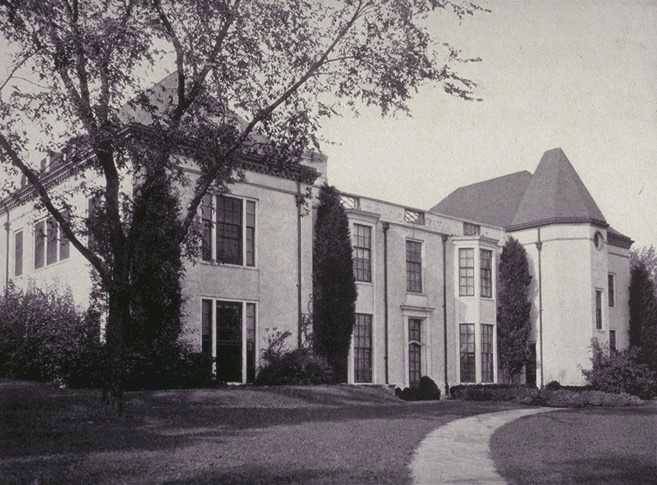

The last club built, Arbor Inn, is an unexceptional design, but nonetheless laden with visual symbolism. Built in 1935, this mock French chateau bears no traces of the dominant styles of Prospect Avenue -- Colonial, Georgian, and Gothic. Although the club system was more entrenched than ever by the mid- 30s, the world was changing and the design of Arbor Inn is significant in its adoption of a new period and a different style. By consciously rejecting old models, Arbor represents the culmination of the move away from highly formal club designs.
Thus the oldest and newest club buildings -- Tiger Inn and Arbor Inn -- form odd stylistic bookends around the mostly classical architectural development of Prospect Avenue. Tiger represents the only survivor of the clubs' first architectural phase, that less formal period that resonated of 19th-century resort life. Arbor Inn, modeled on a simple French country chateau, brings the evolution of the clubs back full circle to their modest origins. It marks the conclusion of the trend that started as far back as 1909, when Campus Club backed off from the challenge of matching the opulence of its peers.
In this regard, Arbor's rapid demise -- the club folded in 1939, after only four years in its new building -- seems somehow fitting. After all, the eating clubs started as loose- knit, short- lived associations, and their early choice of architectural styles reflected their informal character. The distinctly informal design (and questionable institutional vitality) of Arbor a half- century later harkens back to those uncertain early days. It is as if the Georgian splendor of Cottage Club had never been.
This cycle serves once again to remind us of the brevity and singularity of the club phenomenon. By the 1930s, the chance convergence of time, money, ambition, and architecture that created the Prospect Avenue of today had vanished under the economic and social pressures of the Depression. The great era of club construction was over, never to return.