
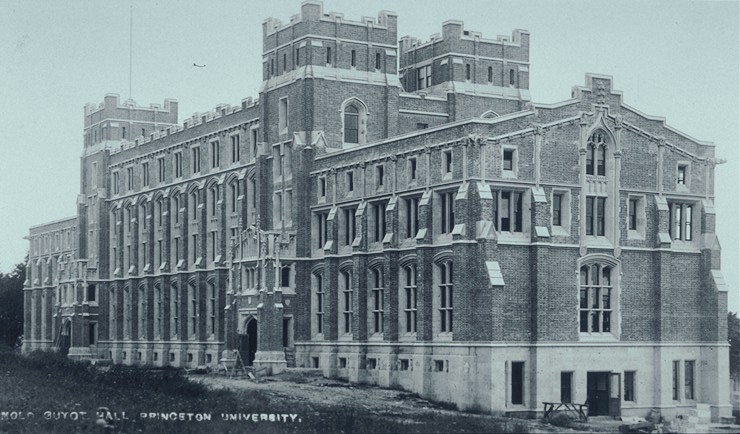
Guyot Hall viewed from the northwest, shortly after completion
Princeton University. Property of the Trustees of Princeton University.
Source: Princeton University Archives, Mudd Library, Grounds & Buildings, SP 3
Princeton University. Property of the Trustees of Princeton University.
Source: Princeton University Archives, Mudd Library, Grounds & Buildings, SP 3

The last academic building constructed during Wilson's tenure was Guyot Hall, located south of Palmer. Begun in 1908 and completed the following year, this building provided space for the geology and the biology departments, then crowded into the old Class of 1877 Biological Laboratory. Guyot housed many of the objects formally located in the E. M. Museum in the new Museum of Natural History located on the ground floor. In fact, the building was named in honor of Professor Arnold Guyot, who had built the geological collections and curriculum in the 1870s and 1880s.
The architects, Parrish and Schroeder, conceived of an enormous quadrangle measuring 288 feet by 256 feet. But only the north wing of this proposed structure was erected: a four-story building 288 feet long and 60 feet deep, with four square towers paired near the center. At the base of the front towers were the entrances to the building; the rear towers contained elevator shafts.
Like Palmer and 1879 Hall, Guyot was a brick expression of the Collegiate Gothic style, although it differed in several respects from either of its neighbors. Unlike Palmer and 1879 Hall, which have steeply pitched slate roofs and gables, the roof of Guyot was of tin and almost flat. With its crenellations and symmetrical towers, it more closely resembled a medieval fortification than an academic building. Guyot also featured a darker shade of brick than either Palmer or 1879 Hall.
Since 1909, Guyot has been renovated several times and expanded frequently. With the construction of the George M. Moffett Biological Laboratory and, more recently, the George LaVie Schultz Laboratory to the south, Parrish and Schroeder's original vision of a massive quadrangle devoted to biology and geology has finally been realized.
In Wilson's time, however, Guyot Hall by itself represented a major step forward in Princeton's scientific facilities. Not only did it free space in the Green School of Science for the rapidly expanding engineering program, but it also signaled Princeton's continued commitment to a first-rate program in the natural sciences.