
Holder Hall
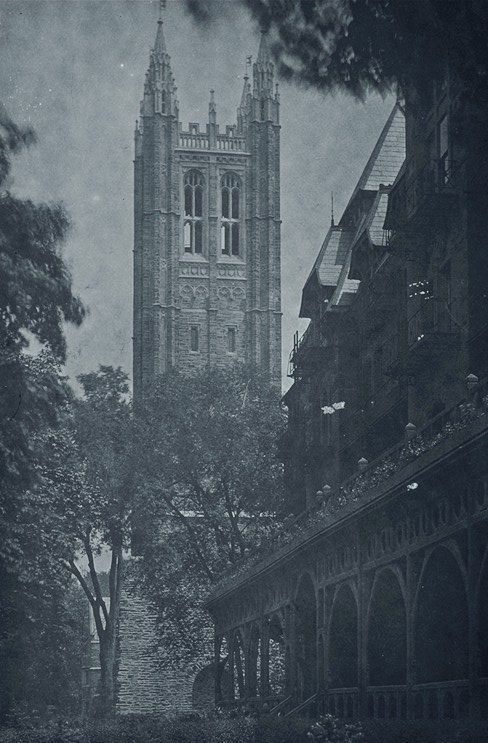
Princeton University. Property of the Trustees of Princeton University.
Tower, viewed from west, with University Hall in foreground (photo before 1916).
Source: Princeton University Archives, Mudd Library, Grounds & Buildings, SP 4

the Collegiate Gothic style to a large degree still defines the architecture of modern Princeton. The spires and gargoyles that so entranced Fitzgerald, the arches used by the a capella singing groups, and the countless other symbols embedded deep in university's ethos all derive from this period.
To be sure, the fateful decision in the 1890s to abandon the High Victorian Gothic models of the 1870s and 1880s in favor of the Collegiate Gothic -- a decision that would dominate construction on the campus for four decades -- was hardly Patton's alone. The Trustees and influential members of the faculty such as Wilson and Dean Andrew Fleming West played a central role in advocating the new style. Indeed, Princeton's increasing self-perception as the New World heir to the Oxford-Cambridge tradition was perhaps the most powerful force.