
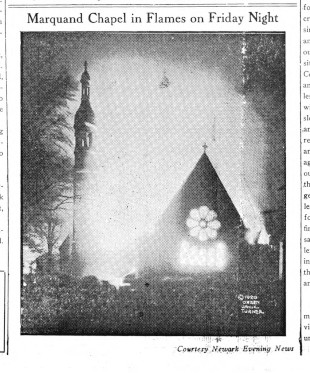
Marquand Chapel in flames
Princeton University. Property of the Trustees of Princeton University.
Source: Daily Princetonian, Volume 41, Number 64, 17 May 1920
Princeton University. Property of the Trustees of Princeton University.
Source: Daily Princetonian, Volume 41, Number 64, 17 May 1920

Life at Princeton University came to a virtual standstill after the United States declared war on Germany in April 1917. Men from the classes of 1917, 1918, and 1919 volunteered en masse; the eating clubs closed, classes were drastically curtailed, and the university commonly buckled down for the duration.
Among the first casualties was Princeton's booming construction program, begun under Woodrow Wilson and continued by John Grier Hibben. Following the 1917 completion of the dining hall complex centered around Madison Hall, Princeton did not erect any new buildings for five years. Shortages of material and skilled labor, combined with the restrictions of the war economy, frustrated the university's expansion plans.
Normalcy returned to campus life only in 1922. In order to make up for these years of privation, and to meet the needs of a now increased undergraduate population, Princeton launched a building campaign that surpassed even the rapid expansion that had occurred before the war. Called the "Campaign for the Endowment Fund," this, the first of Princeton's capital campaigns, focused on upgrading the university's physical plant in five areas: new dormitories; a building for the School of Architecture; a chemistry laboratory; an extension to McCosh Hall; and a new engineering building.
Much of this construction grew out of necessity. Undergraduate enrollment boomed after World War I, which caused a severe shortage of dormitory space, and a series of tragic fires in the 1920s destroyed three of the University's most heavily used facilities: Dickinson Hall, Marquand Chapel, and the John C. Green School of Science.
Looked at in another light, these fires also cleared prime sites in the academic core of the campus for a suite of impressive new structures.