
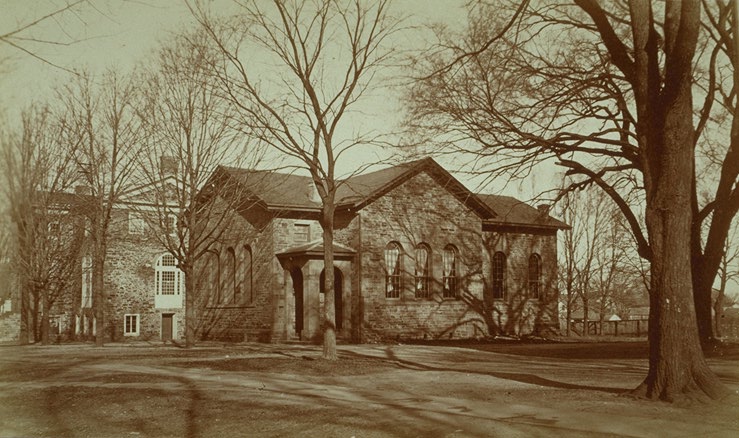
View from southwest, with Philosophical Hall at left (photo before 1870)
Princeton University. Property of the Trustees of Princeton University.
Source: Princeton University Archives, Mudd Library, Grounds & Buildings, Box 21
Princeton University. Property of the Trustees of Princeton University.
Source: Princeton University Archives, Mudd Library, Grounds & Buildings, Box 21

The pulpit and entrance were both located in the west end of the building, an unusual position for a Christian church. In practice, this meant that as students entered the Chapel, as they did early every morning, they had to pass near the pulpit on their way to find seats. For laggards, this orientation meant no slinking in late. Every President of the College before Woodrow Wilson was an ordained minister, and during the antebellum era the President would have been in pulpit as often as not.
The chapel seated 325 -- more than the student population of the day. Simply carved wooden arches supported the vaulted roof and simple wooden pews filled the nave and both transepts. A large and handsome organ occupied the east end of the structure. For a traditional Presbyterian institution such as Princeton, the inclusion of transepts was highly controversial. Indeed, in the minds of some conservative Trustees, the cruciform shape resulted in a suspiciously "papist" look, and opponents of Notman's design lodged heated protests.
In fact, the transepts on the chapel were quite shallow and it seems implausible that Notman was trying to challenge the College's religious sensibilities in his design. More likely, Notman adopted the cruciform shape as a part of the Italianate Revival style's interest in masses and voids, and in response to the chapel's physical context, next to East College, Philosophical Hall, and Nassau Hall. The cruciform shape and exterior materials of the chapel harmonized well with its neighbors. The other main campus buildings were also rectangular structures, three of them with projecting pavilions that suggested a cruciform shape.
The use of the Chapel for secular activities (such as debating contests) undermined its intended religious orientation. President James Carnahan had hoped that a new and beautiful Chapel would encourage piety and religious devotion among the students, but the wear and tear of daily use diminished its impressiveness.