
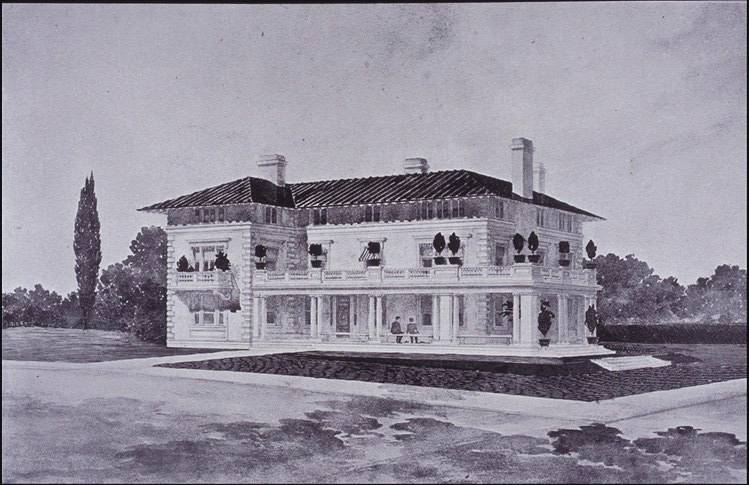
Elm Club in architect's rendering
Princeton University. Property of the Trustees of Princeton University.
Source: Bric-a-Brac, 1902, p.184
Princeton University. Property of the Trustees of Princeton University.
Source: Bric-a-Brac, 1902, p.184

At the time, Prospect Avenue was still a hodgepodge of architectural styles and Elm's invitingly informal Italianate design did not clash stylistically with its neighbors. Further evidence of Elm's rightful place in the first phase of club development lies in the architect's rendering, which deliberately softens the club's appearance. Elm was intended as an intimate, comfortable building, far different from the elaborately formal clubs to come.
With the completion of Elm at the turn of the century, the first period in the evolution of Prospect Avenue draws to a close. Viewed from above, Prospect Avenue c. 1897 bears only the faintest indicators of its current appearance. On the south side of the street, in order, stand the West, Osborn, McCosh, and Fine Houses. The first eating club found on this side of the street is Cap & Gown, and next to it Cottage. On the north side, Ivy and Tiger Inn, with Elm soon to follow.
Within 10 years, this view would change considerably as the club system exploded in popularity. This increased the demand for club buildings, and in turn, the older and more established clubs began to build new, larger, and more urban clubhouses in late 1890s. Thus began the great game of musical chairs that accompanied the rise of the club system at the turn of the century.