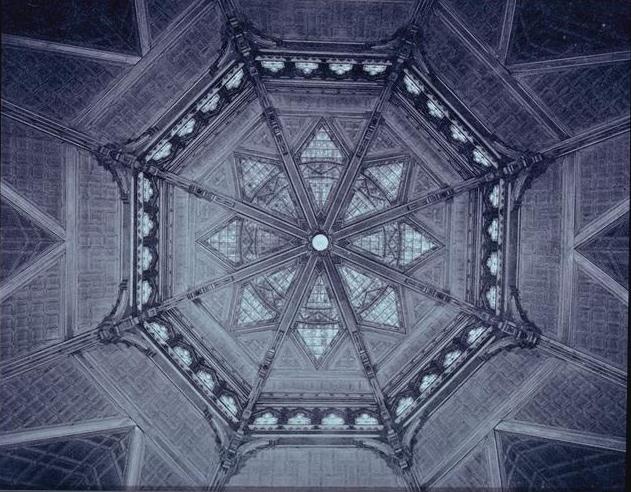
Interior, rotunda, view into cupola (photo 1970's)
Princeton University. Property of the Trustees of Princeton University.
Source: Unknown
The interior of the rotunda remains the library's chief architectural achievement, however. Potter's biographer describes this impressive space:
A diadem set with stained glass windows, it crowns the segmented and buttressed walls. Eight cross gables, each containing a large fan-shaped window, intersect the main roof, which culminates in an octagonal dome light. The domical roofs of the central building and wings are banded by narrow clerestories like Edward T. Potter's [William Potter's brother, also an architect] churches, and delicate iron crests decorate the roofs.
When built, Chancellor Green could hold 150,000 books -- or three times the extent of the College's holdings in 1870 -- and had seating for 100 students. Within 15 years, though, Chancellor Green was overflowing, reflecting both the dramatic expansion of the College and in academic learning. Relief came with the erection of Pyne Library in 1897.
Chancellor Green's rotunda was attached to the new library by a "hyphen" and served as the new reading room for the library. In 1913, the smaller west reading room was converted into the Trustee's meeting room by the firm of Cram, Goodhue, and Ferguson, complete with a carved oak ceiling, pointed windows, and rosewood paneling.
Since Firestone Library was built, Chancellor Green has served as a coffee house, student pub, and part of the student center. To help make way for the new library, the Joseph Henry House was moved in front of Chancellor Green, which blocked the fine perspective from Nassau Street. Today, a row of trees also helps screen the building from view.


The interior of the rotunda remains the library's chief architectural achievement, however. Potter's biographer describes this impressive space:
A diadem set with stained glass windows, it crowns the segmented and buttressed walls. Eight cross gables, each containing a large fan-shaped window, intersect the main roof, which culminates in an octagonal dome light. The domical roofs of the central building and wings are banded by narrow clerestories like Edward T. Potter's [William Potter's brother, also an architect] churches, and delicate iron crests decorate the roofs.
When built, Chancellor Green could hold 150,000 books -- or three times the extent of the College's holdings in 1870 -- and had seating for 100 students. Within 15 years, though, Chancellor Green was overflowing, reflecting both the dramatic expansion of the College and in academic learning. Relief came with the erection of Pyne Library in 1897.
Chancellor Green's rotunda was attached to the new library by a "hyphen" and served as the new reading room for the library. In 1913, the smaller west reading room was converted into the Trustee's meeting room by the firm of Cram, Goodhue, and Ferguson, complete with a carved oak ceiling, pointed windows, and rosewood paneling.
Since Firestone Library was built, Chancellor Green has served as a coffee house, student pub, and part of the student center. To help make way for the new library, the Joseph Henry House was moved in front of Chancellor Green, which blocked the fine perspective from Nassau Street. Today, a row of trees also helps screen the building from view.