
Commons, 1938
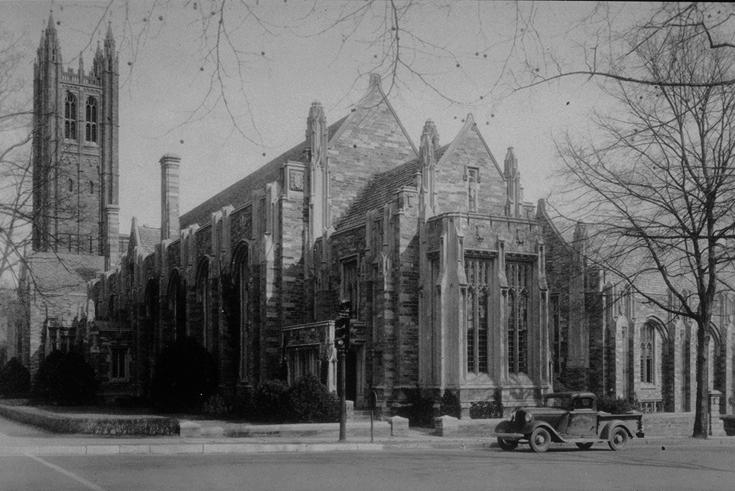
Princeton University. Property of the Trustees of Princeton University.
Source: Princeton University Archives, Mudd Library, Grounds & Buildings, MP 50
Princeton University. Property of the Trustees of Princeton University.
Source: Princeton University Archives, Mudd Library, Grounds & Buildings, MP 50

Work began immediately on plans for the freshmen dining halls that would link Holder and Hamilton. To avoid the problems of one central, cavernous facility, the architects developed five smaller, connected dining halls that were more intimate and suitable to the residential university ideal. The Trustees approved Day and Klauder's designs in April 1915, and for the next two years the northwest corner of the campus was an enormous construction zone.
Collectively referred to as "Commons," Princeton named this new dining complex Madison Hall (composed of Madison, Upper Eagle, and Lower Eagle) and Sage Hall (composed of Upper Cloister and Lower Cloister). Sage Hall, which completed the western wall of Holder Courtyard, was finished in 1916 and Madison Hall was finished the following year. An explicit concession to the elitism of the eating clubs, Commons included a dining area and "club room" reserved for upperclassmen who were not members of clubs.
The Holder and Commons complex was an immediate architectural success. Cram praised its "quality of spontaneous growth" and wrote that it reached "the highest point thus far in the authoritative interpretation of Gothic as a living style." These buildings have stood the test of time; Holder and Hamilton courtyards remain among the most attractive spaces on the Princeton campus.
During the transition to "residential colleges" in the 1980s, the Commons was extensively renovated. Its dining halls were incorporated into Mathey and Rockefeller Colleges as dining facilities and common rooms.