
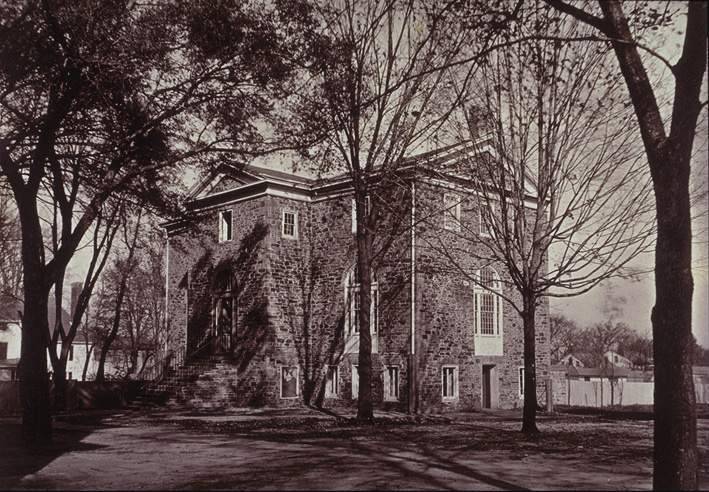
Philosophic Hall viewed from the southwest (photo c.1870)
Princeton University. Property of the Trustees of Princeton University.
Source: Princeton University Archives, Mudd Library, Grounds & Buildings, Box 59
Princeton University. Property of the Trustees of Princeton University.
Source: Princeton University Archives, Mudd Library, Grounds & Buildings, Box 59

The Trustees officially commissioned Geological and Philosophical Halls on 13 April 1803, specifying that the buildings should be "60 feet in length and 40 feet in breadth and three stories high."
Philosophical Hall was designed to serve several purposes. It contained a room for the College's philosophical apparatus (as scientific instruments were then called), as well as classrooms for the teaching of chemistry and natural history. In addition, it was to accommodate a "Kitchen or Cooking room for the use of the Steward of the College," as well as "a large and convenient dining room for the students."
Geological Hall, meanwhile, was primarily designed to provide rooms for classes and studying. Latrobe was also instructed to provide "a room for the reception and handsome exhibition of the Library of the College." The College's two famous debating societies -- the American Whig Society and the Cliosophic Society -- were housed on the top floor of Geological Hall.
As such, Geological Hall soon became a focal point of campus life. In the early 19th century, professors as well as students belonged to Whig and Clio, and the two debating societies contributed considerably to maintaining the college's intellectual vitality.