For most of this period, Princeton's architectural fortunes were in the hands of Ralph Adams Cram, who, as supervising architect, influenced the design and placement of all new buildings on the campus. His essential scheme for Princeton, conceived shortly after his appointment in 1906, called for academic structures to be concentrated in the northeastern section of the campus, with dormitories and other student facilities to the west and south. This overall plan remained in effect throughout the 1920s.
Under the guidance of Cram and Klauder (who was an independent Philadelphia architect whose work was largely compatible with Cram's vision), the University concentrated its efforts in three main areas: the cluster of dormitories west and south of Blair Arch; the chapel-Dickinson complex; and the scientific buildings erected east of Washington Road. Each of these sites was radically altered by construction; the dormitory complex, for instance, went up on land that had formerly been occupied by the Pennsylvania Railroad station.
While these large developments created imposing new parts of the campus, the other interwar buildings grew out of the concurrent "infill" strategy. McCormick, for example, helped to define the courtyard bounded by Edwards, Brown, and Dod, and its "medieval gothic" styling in brownstone was meant to harmonize with its Renaissance Revival neighbors.

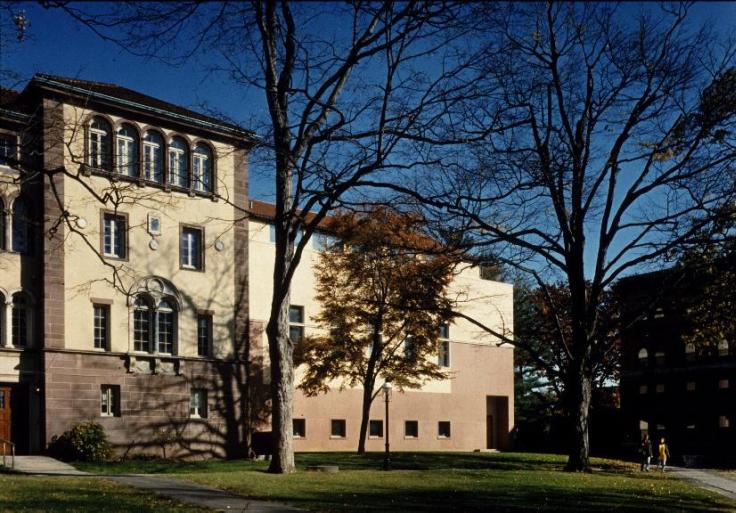

For most of this period, Princeton's architectural fortunes were in the hands of Ralph Adams Cram, who, as supervising architect, influenced the design and placement of all new buildings on the campus. His essential scheme for Princeton, conceived shortly after his appointment in 1906, called for academic structures to be concentrated in the northeastern section of the campus, with dormitories and other student facilities to the west and south. This overall plan remained in effect throughout the 1920s.
Under the guidance of Cram and Klauder (who was an independent Philadelphia architect whose work was largely compatible with Cram's vision), the University concentrated its efforts in three main areas: the cluster of dormitories west and south of Blair Arch; the chapel-Dickinson complex; and the scientific buildings erected east of Washington Road. Each of these sites was radically altered by construction; the dormitory complex, for instance, went up on land that had formerly been occupied by the Pennsylvania Railroad station.
While these large developments created imposing new parts of the campus, the other interwar buildings grew out of the concurrent "infill" strategy. McCormick, for example, helped to define the courtyard bounded by Edwards, Brown, and Dod, and its "medieval gothic" styling in brownstone was meant to harmonize with its Renaissance Revival neighbors.