
McCosh Hall viewed from the north (photo early 1920's?)
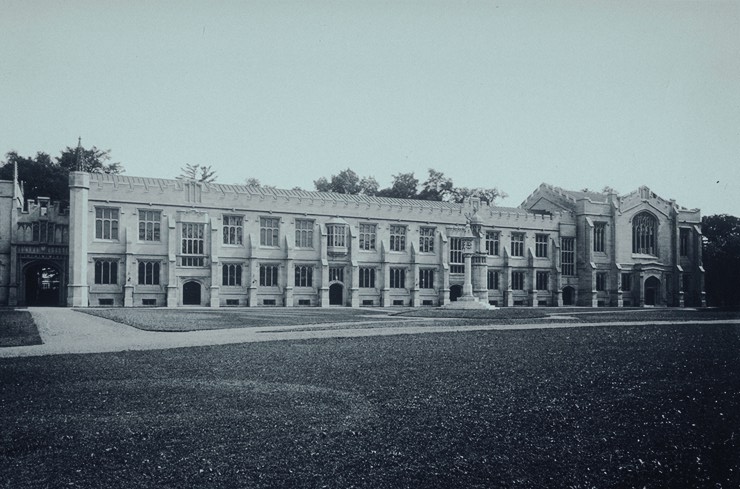
Princeton University. Property of the Trustees of Princeton University.
Source: Princeton University Archives, Mudd Library, Grounds & Buildings, MP 51
Princeton University. Property of the Trustees of Princeton University.
Source: Princeton University Archives, Mudd Library, Grounds & Buildings, MP 51

Alumni who returned to Princeton for Reunions in the years immediately before the World War One could be excused for barely recognizing their alma mater. Veterans of the McCosh era, these alumni had witnessed Princeton's rejuvenation under his vigorous leadership. But in the twenty years following the 1896 Sesquicentennial, the University experienced nothing short of revolutionary change on almost all levels.
Woodrow Wilson, the energetic president elected in 1902, radically reformed the curriculum, instituted the preceptorial system, and raised entrance standards. The construction of the Graduate College under Hibben made Princeton a true university, and Princeton's national reputation rose accordingly. This period also saw the rise of the upperclass eating clubs' power and prestige.
As revolutionary was the physical transformation of the Princeton campus. By the time war was declared in 1917, the pastoral High Victorian campus envisioned by Frederick Olmsted in his "park plan" of 1893 had given way to a series of Collegiate Gothic quadrangles, soaring memorial towers, and richly carved archways. The new style permeated the campus: the gymnasium, the physics laboratory, and even the infirmary faithfully drew on the architectural precedents of Oxford and Cambridge.
This homogeneity was entirely by design. In 1896, the Trustees announced that all structures henceforth built at Princeton would be in the Collegiate Gothic style. In 1907, to enforce this new stylistic conformity, they hired architect Ralph Adams Cram -- who has been called the "high priest" of American Collegiate Gothic -- as Supervising Architect. Cram had powerful faculty allies including President Wilson, Dean Andrew Fleming West, and John Grier Hibben, who succeeded Wilson as president in 1912.
Cram's appointment marked a distinctive new phase in the architectural development of the Princeton campus. With the style of each new building predetermined, more attention would be given to the location of new structures than on their particular architectural details. In addition, because of the rapid growth of the University throughout this time, Cram's planning addressed groups of structures, not simply individual buildings.
Most importantly, for the future development of the campus, Princeton adopted the overarching site plan that still guides the University's expansion. Cram divided the campus into four quadrants with the north-south axis originating from Nassau Hall and the east-west axis running along McCosh Walk.
In general, undergraduate dormitories were in the western half and the academic structures were in the eastern half. As a testament to the political skills of Dean West, the Graduate College stood far apart from the rest of the campus.
New and important structures such as McCosh Hall,