Princeton University. Property of the Trustees of Princeton University.
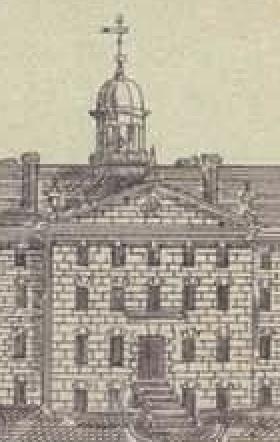
Together, they devised the plans for a structure that measured 177 feet long and 53 feet wide -- enormous for the time. Its plain sandstone walls were 26 inches thick and penetrated by dozens of tall, narrow windows.
Ground was broken for the new building on July 24, 1754, and the cornerstone -- the northwest corner -- was laid in September of the same year. By November 1755, Nassau Hall's hipped roof was raised and by the following spring the building was nearing completion.
The building rose three full stories, plus the half-basement. This half-basement not only allowed some natural light to penetrate the dank recesses of the basement, but also had the practical effect of helping keep it from flooding constantly. Central New Jersey has a high water table, and the basement rooms of Nassau Hall were perennially damp.
Smith's scheme for Nassau Hall drew on a number of antecedents. Princeton historians have tried, without great success, to find Smith's models, which he would have known through architectural pattern books. In the view of the Princeton historian T.J. Wertenbaker, for instance, Nassau Hall resembles an unornamented version of King's College, Cambridge. According to legend, Smith owned a copy of a popular building primer of the time, Gibbs's A Book of Architecture, which included a reproduction of King's College. The cupola, Wertenbaker says, is a copy of St. Mary-le-Strand, also shown in Gibbs; the main doorway was borrowed from Batty Langley's A Builder's Treasury of Designs.
What is uncontestable is that Smith brought his architectural knowledge to bear on the problem of erecting an impressive, functional, and appropriately inexpensive structure to house the College. By these standards, he succeeded and created a building worthy to stand with its peers.
Structurally, Smith's Nassau Hall is a sturdy "double pile," having two blocks extending from a central pavilion. Three doors opened onto the front lawn facing the King's Highway, and two onto the back. The Trustees originally specified that the structure be built of brick -- but only if good brick could be made cheaply and easily in Princeton. Apparently this could not be done, or perhaps local sandstone was cheaper, because the building was executed in stone.
In any event, the rough, simple sandstone of Nassau Hall was well suited to the chaste sensibilities of the College. Certainly President Aaron Burr, Sr. was not exaggerating when he wrote to a donor in Scotland, "We do everything in the plainest and cheapest manner, as far as is consistent with Decency and Convenience, having no superfluous Ornaments."


Together, they devised the plans for a structure that measured 177 feet long and 53 feet wide -- enormous for the time. Its plain sandstone walls were 26 inches thick and penetrated by dozens of tall, narrow windows.
Ground was broken for the new building on July 24, 1754, and the cornerstone -- the northwest corner -- was laid in September of the same year. By November 1755, Nassau Hall's hipped roof was raised and by the following spring the building was nearing completion.
The building rose three full stories, plus the half-basement. This half-basement not only allowed some natural light to penetrate the dank recesses of the basement, but also had the practical effect of helping keep it from flooding constantly. Central New Jersey has a high water table, and the basement rooms of Nassau Hall were perennially damp.
Smith's scheme for Nassau Hall drew on a number of antecedents. Princeton historians have tried, without great success, to find Smith's models, which he would have known through architectural pattern books. In the view of the Princeton historian T.J. Wertenbaker, for instance, Nassau Hall resembles an unornamented version of King's College, Cambridge. According to legend, Smith owned a copy of a popular building primer of the time, Gibbs's A Book of Architecture, which included a reproduction of King's College. The cupola, Wertenbaker says, is a copy of St. Mary-le-Strand, also shown in Gibbs; the main doorway was borrowed from Batty Langley's A Builder's Treasury of Designs.
What is uncontestable is that Smith brought his architectural knowledge to bear on the problem of erecting an impressive, functional, and appropriately inexpensive structure to house the College. By these standards, he succeeded and created a building worthy to stand with its peers.
Structurally, Smith's Nassau Hall is a sturdy "double pile," having two blocks extending from a central pavilion. Three doors opened onto the front lawn facing the King's Highway, and two onto the back. The Trustees originally specified that the structure be built of brick -- but only if good brick could be made cheaply and easily in Princeton. Apparently this could not be done, or perhaps local sandstone was cheaper, because the building was executed in stone.
In any event, the rough, simple sandstone of Nassau Hall was well suited to the chaste sensibilities of the College. Certainly President Aaron Burr, Sr. was not exaggerating when he wrote to a donor in Scotland, "We do everything in the plainest and cheapest manner, as far as is consistent with Decency and Convenience, having no superfluous Ornaments."