
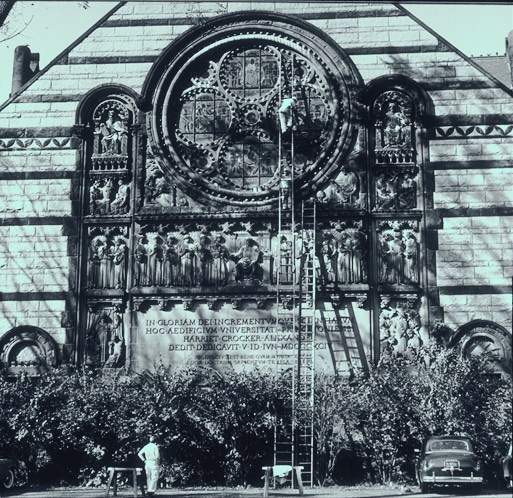
South facade, with workers cleaning window (photo 1940s or 50s)
Princeton University. Property of the Trustees of Princeton University.
Source: Princeton University Archives, Mudd Library, Grounds & Buildings, MP 2
Princeton University. Property of the Trustees of Princeton University.
Source: Princeton University Archives, Mudd Library, Grounds & Buildings, MP 2

Centered underneath the rose window is a bas-relief sculpture of 36 figures. Designed by J.A. Bolger and executed by J. Massey Rhind, these figures revolve around the seated figure that represents Learning. The figures to his left represent the fields of Oratory, Theology, Law, History, Philosophy, and Ethics; to his right, Architecture, Sculpture, Painting, Poetry, Music, and Belles-Lettres. The figure in the large panel to the left, above Learning, represents Law, that to the upper right, Religion. The carving of these sculptures continued long after the building was dedicated on June 9, 1894.
In the context of the modern Princeton campus, the location of Alexander Hall -- to the west of Nassau Hall and behind the Presbyterian Church -- seems a bit odd. But at the time, Potter urged the Trustees to demolish the old Greek Revival church, which would have created a large open area running along the entire northern side of the campus.
In that event, Nassau Hall would have been framed by two Potter buildings: Chancellor Green to the east, and Alexander Hall to the west - featuring tall dormers and strong geometric patterns. This plan would have fulfilled McCosh's vision for a Princeton campus set in a park-like environment and separated from Nassau Street by a long, wide green.
Alexander Hall was the last High Victorian Gothic building constructed at Princeton. In recent years, Alexander Hall has made something of a comeback in terms of use and popularity. It was extensively renovated in 1985 (it is now known as David B. Richardson '33 Auditorium in Alexander Hall), and its fine qualities as a lecture and recital space are increasingly appreciated - even by undergraduates.