Princeton University. Property of the Trustees of Princeton University.
Source: Unknown
Princeton's solution was to construct the E-Quad -- a large complex of five buildings on the former grounds of University Field at the eastern edge of the campus.
The E-Quad -- formally known as the School of Engineering and Applied Science -- went through several mutations on its way to its current site and form. When the University first announced its plans for a new group of engineering buildings in 1956, the proposed site was the area on William Street behind Tiger Inn and Elm Club. The estimated cost was $8 million, and the only delay in breaking ground, the University noted, was fundraising.
Three years later, though, the site jumped east across Olden Street and onto University Field, the location of Princeton's venerable baseball stadium. Planners for the University had decided that the William Street site was too small to handle the kind of long-term growth envisioned for the sciences, and the only realistic option was to expand further east.
The decision to raze the site of so many memorable contests brought predictable grumbles from the alumni. (They complained again in 1995, when the University announced plans to replace Palmer Stadium with a smaller and more modern facility.) The change in new site also caused the architect, Stephen Voorhees '00, to reconfigure the complex into its final shape.
Voorhees, a former university trustee, devised a quadrangle of four-story brick halls, with a fifth hall extending south, parallel to the Olden Street. Functional, unornamented buildings with limestone trim and aluminum windows, the five halls of E-Quad provided 275,000 square feet of classroom, laboratory, and office space. The scale was impressive: half a million bricks and 400 windows went into the exterior; the interior walls required 15,000 cinder blocks and the building had 4,000 feet of corridors. Construction began in October 1960 and it was dedicated two years later.

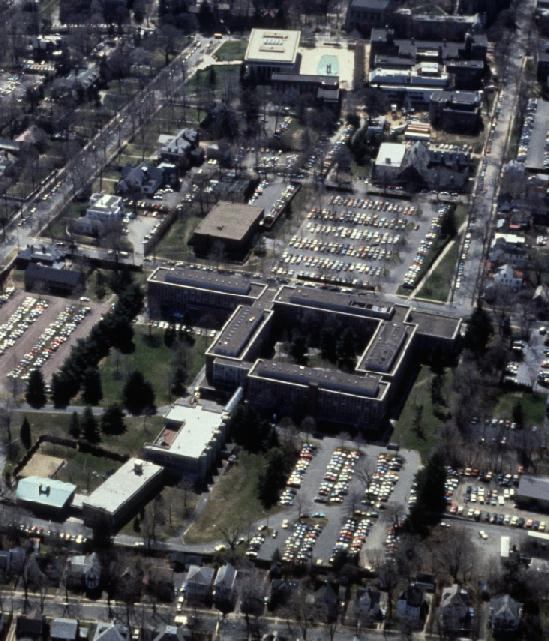

Princeton's solution was to construct the E-Quad -- a large complex of five buildings on the former grounds of University Field at the eastern edge of the campus.
The E-Quad -- formally known as the School of Engineering and Applied Science -- went through several mutations on its way to its current site and form. When the University first announced its plans for a new group of engineering buildings in 1956, the proposed site was the area on William Street behind Tiger Inn and Elm Club. The estimated cost was $8 million, and the only delay in breaking ground, the University noted, was fundraising.
Three years later, though, the site jumped east across Olden Street and onto University Field, the location of Princeton's venerable baseball stadium. Planners for the University had decided that the William Street site was too small to handle the kind of long-term growth envisioned for the sciences, and the only realistic option was to expand further east.
The decision to raze the site of so many memorable contests brought predictable grumbles from the alumni. (They complained again in 1995, when the University announced plans to replace Palmer Stadium with a smaller and more modern facility.) The change in new site also caused the architect, Stephen Voorhees '00, to reconfigure the complex into its final shape.
Voorhees, a former university trustee, devised a quadrangle of four-story brick halls, with a fifth hall extending south, parallel to the Olden Street. Functional, unornamented buildings with limestone trim and aluminum windows, the five halls of E-Quad provided 275,000 square feet of classroom, laboratory, and office space. The scale was impressive: half a million bricks and 400 windows went into the exterior; the interior walls required 15,000 cinder blocks and the building had 4,000 feet of corridors. Construction began in October 1960 and it was dedicated two years later.