Princeton University. Property of the Trustees of Princeton University.
Even as the dormitories of New Quad were opening their doors to their first undergraduates, plans were well underway to build a second entire matched complex of dormitories immediately to the south. These buildings -- Lourie-Love, 1922, 1940, 1941, and 1942 Halls -- inevitably became known as "New New Quad," a name they retained until the construction of Wu Hall in 1983 and the creation of Butler College.
The Butler College dorms added almost 100,000 square feet of dormitory space, enough for some 325 students, and cost $2.3 million. They were designed by Hugh Stubbins, who wrote at the time that his design was not a sharp break with the traditional Gothic of the upper campus. Rather, he sought "to capture the traditional scale in a modern idiom."
Stubbins achieved this effect by varying the number of stones in each unit, staggering the wall planes of the New New Quad buildings, and punctuating the walls with thin vertical lines. "This is in keeping with the buttresses and crenellations of the old Gothic buildings," he explained. Stubbins also sited the five buildings to create two modest but connected courtyards, in contrast to the large single quadrangle of New Quad.
Not all alumni were impressed. As one wrote to the Princeton Alumni Weekly, "Why a low-income urban renewal project in the middle of those beautiful fields?" (New New Quad had continued the southward march of the campus onto the playing fields, encroaching onto what had been Goldie Field.)
Construction of the Stubbins buildings started in 1963, and most of them were ready for occupancy by the autumn of 1964. Although the addition of these dormitory spaces relieved overcrowding, it proved only a temporary expedient. The advent of coeducation in 1969 and increased demand for married undergraduate housing forced Princeton to construct one final complex of dorms, the eight units of Spelman Hall.

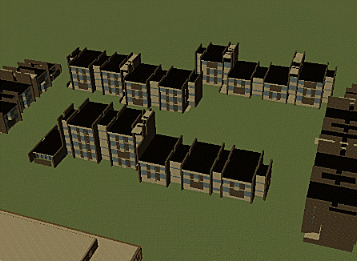

Even as the dormitories of New Quad were opening their doors to their first undergraduates, plans were well underway to build a second entire matched complex of dormitories immediately to the south. These buildings -- Lourie-Love, 1922, 1940, 1941, and 1942 Halls -- inevitably became known as "New New Quad," a name they retained until the construction of Wu Hall in 1983 and the creation of Butler College.
The Butler College dorms added almost 100,000 square feet of dormitory space, enough for some 325 students, and cost $2.3 million. They were designed by Hugh Stubbins, who wrote at the time that his design was not a sharp break with the traditional Gothic of the upper campus. Rather, he sought "to capture the traditional scale in a modern idiom."
Stubbins achieved this effect by varying the number of stones in each unit, staggering the wall planes of the New New Quad buildings, and punctuating the walls with thin vertical lines. "This is in keeping with the buttresses and crenellations of the old Gothic buildings," he explained. Stubbins also sited the five buildings to create two modest but connected courtyards, in contrast to the large single quadrangle of New Quad.
Not all alumni were impressed. As one wrote to the Princeton Alumni Weekly, "Why a low-income urban renewal project in the middle of those beautiful fields?" (New New Quad had continued the southward march of the campus onto the playing fields, encroaching onto what had been Goldie Field.)
Construction of the Stubbins buildings started in 1963, and most of them were ready for occupancy by the autumn of 1964. Although the addition of these dormitory spaces relieved overcrowding, it proved only a temporary expedient. The advent of coeducation in 1969 and increased demand for married undergraduate housing forced Princeton to construct one final complex of dorms, the eight units of Spelman Hall.