
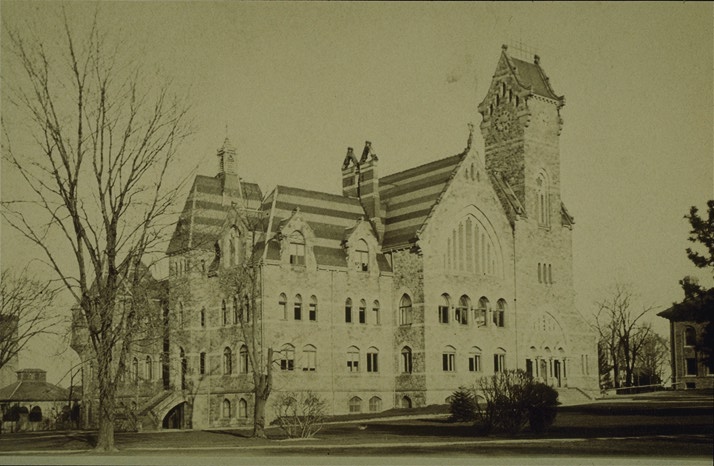
View from northwest (photo circa 1890)
Princeton University. Property of the Trustees of Princeton University.
Source: Princeton University Archives, Mudd Library, Grounds & Buildings, SP6
Princeton University. Property of the Trustees of Princeton University.
Source: Princeton University Archives, Mudd Library, Grounds & Buildings, SP6

The asymmetry and massing of the building indicated the different functions of the rooms behind. The smaller windows on the first two floors opened onto laboratories and classrooms, while the large arched window in the center opened onto the museum. Helping unify these disparate elements is the clock tower, which extends unbroken from top to base.
Appearances aside, the facilities within the School of Science enabled a revolution in scientific research and the teaching of science at Princeton. This purpose-built science building, with adequate laboratory space, mirrored McCosh's view that "lectures without experiments performed by students may widen the mind, but they will not make chemists or give accurate scientific knowledge."
Better facilities also helped lure better scientists to Princeton. John C. Green provided $100,000 for the building and an additional $100,000 to endow professorships in the sciences. Princeton was competing for students and faculty with the science programs at Harvard and Yale, and McCosh focused much of his fundraising efforts on the School of Science.
Joseph Henry, the former Princeton professor and the first director of the Smithsonian Institution, delivered the inaugural address for the School of Science in May 1873. The building opened for classes in September of that year and completed early in 1874.