Princeton University. Property of the Trustees of Princeton University.
Source: Unknown
In its place Yamasaki erected a building unlike any other on the campus: an imposing, four-story modernist Greek temple ringed by 58 tapered pillars. Featuring such inventive elements as the "bowl" auditoriums in the basement; the 28-foot-tall central atrium; Dodds Auditorium; and its two-level library, the design of the Wilson School also sent a symbolic message. As Dean Marver Bernstein wrote at the time, "the sharp contrast between Yamasaki's design and the Gothic campus was deliberately intended to evoke the Wilson School's role as a professional institution that drew on models different from those of Princeton's pure academic tradition."
Robertson Hall remains one of the most distinctive structures on the campus. The plaza in front of the Wilson School, with its large reflecting pool and "Fountain of Freedom" sculpture, has also emerged as one of Princeton's signature spaces.
The construction of the Wilson School also coincided with the end of a long tradition, when 1879 Hall -- the only dormitory ever built on the eastern side of the campus -- was converted into offices for the philosophy department. By the end of the 1960s, therefore, the departments of the humanities and social sciences had taken hold over the northeast quadrant of the campus that Ralph Adams Cram had identified as far back as 1907 as the academic core of the University

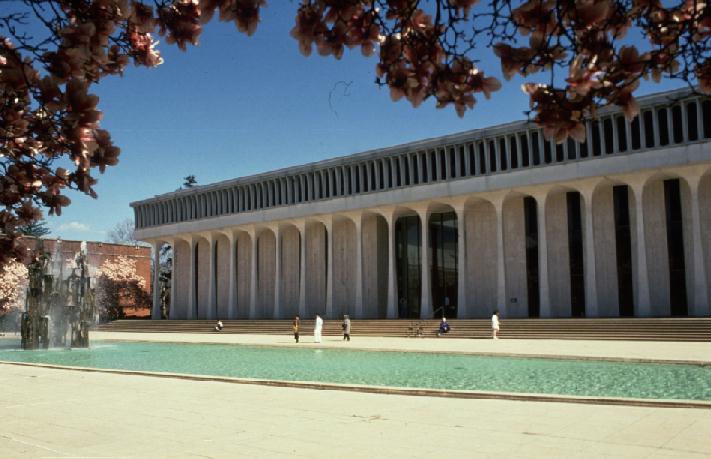

In its place Yamasaki erected a building unlike any other on the campus: an imposing, four-story modernist Greek temple ringed by 58 tapered pillars. Featuring such inventive elements as the "bowl" auditoriums in the basement; the 28-foot-tall central atrium; Dodds Auditorium; and its two-level library, the design of the Wilson School also sent a symbolic message. As Dean Marver Bernstein wrote at the time, "the sharp contrast between Yamasaki's design and the Gothic campus was deliberately intended to evoke the Wilson School's role as a professional institution that drew on models different from those of Princeton's pure academic tradition."
Robertson Hall remains one of the most distinctive structures on the campus. The plaza in front of the Wilson School, with its large reflecting pool and "Fountain of Freedom" sculpture, has also emerged as one of Princeton's signature spaces.
The construction of the Wilson School also coincided with the end of a long tradition, when 1879 Hall -- the only dormitory ever built on the eastern side of the campus -- was converted into offices for the philosophy department. By the end of the 1960s, therefore, the departments of the humanities and social sciences had taken hold over the northeast quadrant of the campus that Ralph Adams Cram had identified as far back as 1907 as the academic core of the University