
Woodrow Wilson School (now Corwin Hall) just prior to move
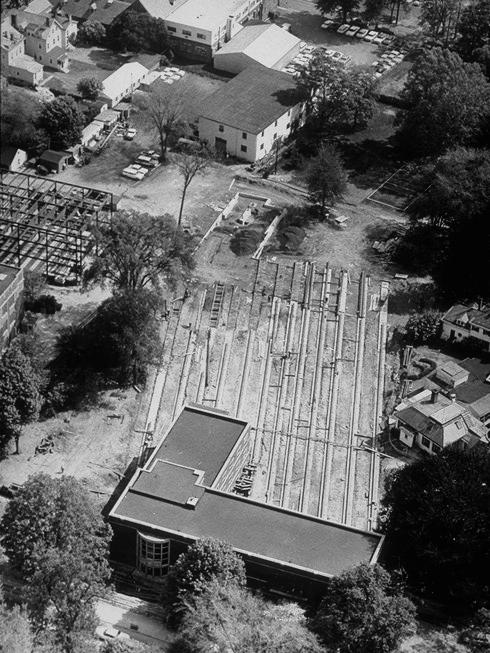
Princeton University. Property of the Trustees of Princeton University.
Source: Princeton University Archives, Mudd Library, Grounds & Buildings, MP30
Princeton University. Property of the Trustees of Princeton University.
Source: Princeton University Archives, Mudd Library, Grounds & Buildings, MP30

Now called Corwin Hall, this L-shaped building stands today at the rear of the large plaza and fountain in front of Robertson Hall, 100 yards east of its original location.
Its most notable feature was (and remains) a windowless western facade, a long expanse of brick broken only by the two-story limestone-accented doorway at the northern end. The shorter leg of the "L", perpendicular to Washington Road, stretched back 75 feet; both this leg and the eastern facade were amply provided with windows.
The blank brick wall, intended to reduce noise from nearby Washington Road, immediately elicited complaints from the undergraduates. "Dull and unimaginative," one wrote; a student graffittist inspired by Shelley painted "look on my work, ye mighty, and despair" on the hated wall.
In fairness to architect Stephen Voorhees, Class of 1900, the location selected for the new Wilson School building was problematic. This relatively small site was bounded by the Frick to the north, 1879 to the east, and the Observatory of Instruction to the south: three entirely contrasting structures. Moreover, Washington Road was a major truck thoroughfare carrying an increasing load of traffic. And near the corner of Washington Road and Prospect Avenue stood a large and beautiful copper beech tree that Voorhees was careful to leave standing.
Given these constraints, the overall scheme and choice of materials for Corwin made sense. The use of brick and limestone bridged the gap between 1879 and Frick, while the long brick facade significantly reduced traffic noise. Although the final cost exceeded $650,000, well over budget, the building was still relatively inexpensive.
With the completion of Corwin in 1952, building activity on the campus tailed off dramatically. In the five years since 1947, the University had swiftly addressed its most pressing needs on the main campus, and for the remainder of the 1950s, the University grew in other ways. Indeed, Corwin proved to be the last building dedicated by Harold Dodds during his twenty four years as president.