
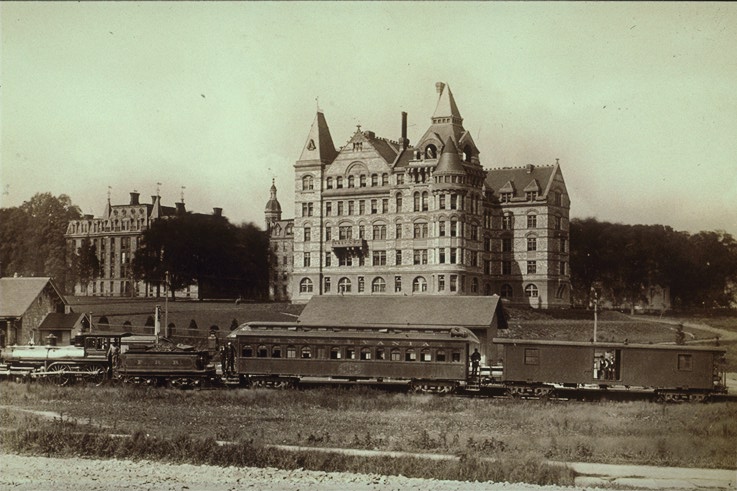
View from southwest, with Pennsylvania Railroad station in foreground (photo circa 1878)
Princeton University. Property of the Trustees of Princeton University.
Source: Princeton University Archives, Mudd Library, Grounds & Buildings, Box 11
Princeton University. Property of the Trustees of Princeton University.
Source: Princeton University Archives, Mudd Library, Grounds & Buildings, Box 11

Until Blair and Little Halls were built some 20 years later, Witherspoon Hall was the first building newcomers saw upon arriving on campus by train. Accordingly, McCosh wanted a building of sufficient scale and style to impress visitors. Looming five stories, and featuring prominent towers and other bold details, the design for Witherspoon certainly fit the bill.
But McCosh had other motives in constructing Witherspoon. In the wake of the Civil War, the College attracted a more affluent student population. The spartan facilities of many of the college's dormitories were simply unpalatable to this new type of undergraduate. With amenities such as waterclosets on every floor, dumbwaiters, and special corridors and rooms for servants, Witherspoon was tailored to meet the needs of these wealthy students.
In fact, Witherspoon was considered the most modern and elegant dormitory of its time. Harper's Weekly declared the structure "one of the most commanding college buildings in the world." Another contemporary observer wrote that it was "the most beautiful and luxurious college dormitory in the country."
Shaped like an "H", the building accommodated 140 students in 80 rooms. The ground level was constructed of dark, ashlar stone from Newark, while the floors above were made of blue-gray Pennsylvania marble set off with bands of Newark stone. In this regard, Witherspoon was more restrained than some of the aggressively polychromatic High Victorian Gothic buildings of the period.