
Dillon Gym viewed from the southeast
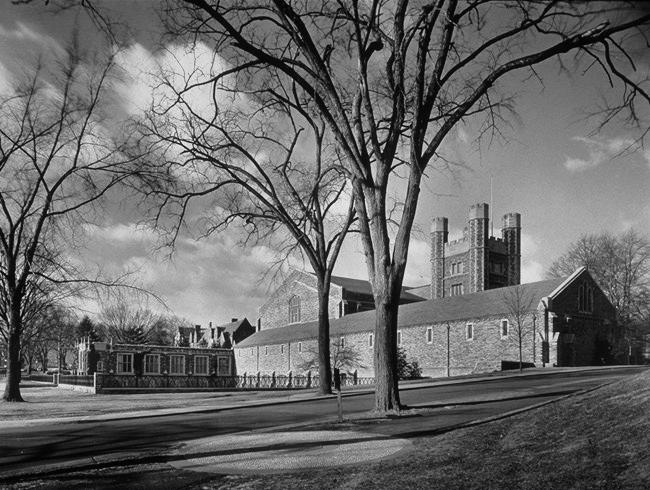
Princeton University. Property of the Trustees of Princeton University.
Source: Princeton University Archives, Mudd Library, Grounds & Buildings, MP39
Princeton University. Property of the Trustees of Princeton University.
Source: Princeton University Archives, Mudd Library, Grounds & Buildings, MP39

He moved the main tower to the east side of the building, from the center over the northern entrance. Embury also included a swimming pool complex to the south, tearing down Brokaw Memorial in the process. Dillon Gymnasium was also considerably bigger than its predecessor, with the main floor measuring 210' by 100' and holding seats for 1,400 spectators.
Princeton's enormously successful Bicentennial celebration in 1946 enabled Dodds to focus finally on his primary interest, a new library. To help underwrite this expensive endeavor, as well as build a new facility for the Woodrow Wilson School, he launched a $20 million capital campaign called the "Third Century Fund".
The plans for the new library came out of a report published in 1944 titled "A Laboratory-Workshop Library for Princeton". The very idea of a "laboratory-workshop library" drew directly on Princeton's focus on independent work in the undergraduate course of study. The new library was intended to be the laboratory for students in the humanities and social sciences, and the design of Firestone Library reflected this intent. Only at Princeton, for example, did undergraduates have priority over graduate students in assignments for study carrels.
The committee planning the library presented the architects, the firm of O'Connor and Kilham, with six design conditions. It was to be a working, "open stack" library, not a storehouse, and the stacks were to be located underground to prevent ultraviolet light from prematurely aging books. The committee wanted a flexible and utilitarian design that was also inexpensive -- "though designed in the Gothic spirit of the rest of the campus, it [should] avoid costly ornamentation and wasted space." There had to be carrels for underclassmen and the whole structure had to have central heating and cooling.
Unusual for such a major structure, there were no objections to the proposed site: between Nassau Street and the chapel, a large area with much room for future expansion. Nonetheless, this site did create a number of stylistic challenges for the architects. Because the adjacent buildings were all of different kinds of stone (limestone in the Chapel, brownstone in Pyne Library and Chancellor Green, fieldstone in Nassau Hall, and local stone in Green and Frick across Washington Road), the choice of materials posed a problem. Furthermore, any structure on this site had to compete with Ralph Adams Cram's imposing chapel across the courtyard. The University's religious roots were still strong enough that the architects had clear, if unstated instructions not to overshadow the chapel.
The architects followed their orders to the letter. In keeping with theme of library-as-laboratory, all of the interior spaces were laid out before the exterior design was considered. Boyd was intimately involved in these designs, and later said that his intent was "not to produce an architectural monument but a humanistic laboratory." The final plans called for a building built on six levels, three of them underground, totaling 300,000 square feet and containing room for 1.8 million volumes. The Collegiate Gothic detailing was restricted primarily to the southern facade, which featured a modest entrance tower.
Writing about the new library in the Princeton Alumni Weekly, Dean Mathey, Class of 1912, the moving force on the Trustees' grounds and buildings committee, said, "The site of course called for a Gothic architectural treatment to harmonize with the Chapel and balance McCosh Hall to the south. The treatment is simple excepting the entrance and tower, which tie into the design of the Chapel." Similarly, the texture of the stone was intended to blend with Nassau Hall and the chapel.