
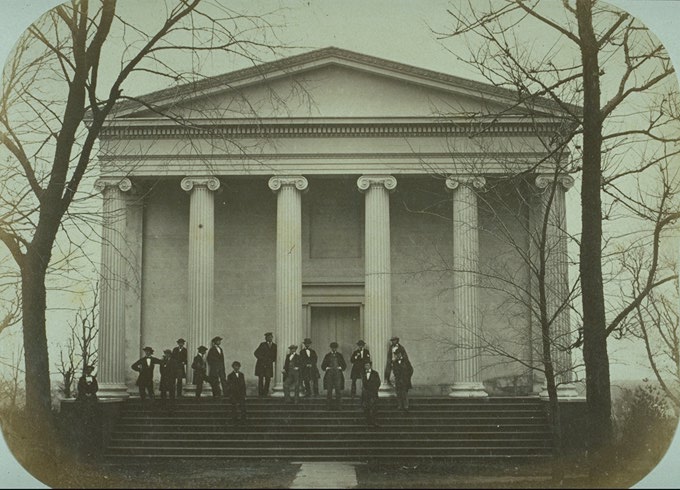
Cliosophic Hall viewed from the north (photo from Class of 1861 album)
Princeton University. Property of the Trustees of Princeton University.
Source: Princeton University Archives, Mudd Library, Grounds & Buildings, Box 26
Princeton University. Property of the Trustees of Princeton University.
Source: Princeton University Archives, Mudd Library, Grounds & Buildings, Box 26

and Clio reflects the importance of these societies in undergraduate life as well as the dominance of the Greek Revival style in that period.
Bitter rivals, the American Whig Society and the Cliosophic Society dominated undergraduate life at the College of New Jersey during the late 18th and most of the 19th centuries. The Halls, as they were known, were independent entities that combined the best and worst elements of secret society, debating club, social center, library, and political organization.
As with the eating clubs of a later generation, Whig and Clio were often a thorn in the side of the College administration. In the 1820s, for example, many of the leading members of the politically liberal Whig Society were expelled for leading demonstrations against the College. It was only one of many incidents of student unrest in this period.
At the same time, however, the Halls enjoyed powerful alumni support and provided services that the College did not. During parts of the Carnahan era, for example, the College's Library was only open one hour a week. By contrast, the Halls maintained fine private libraries and collections of periodicals. The comparative sizes of the Hall's libraries versus the College's can be traced in the description of each in the College's Catalogues.