
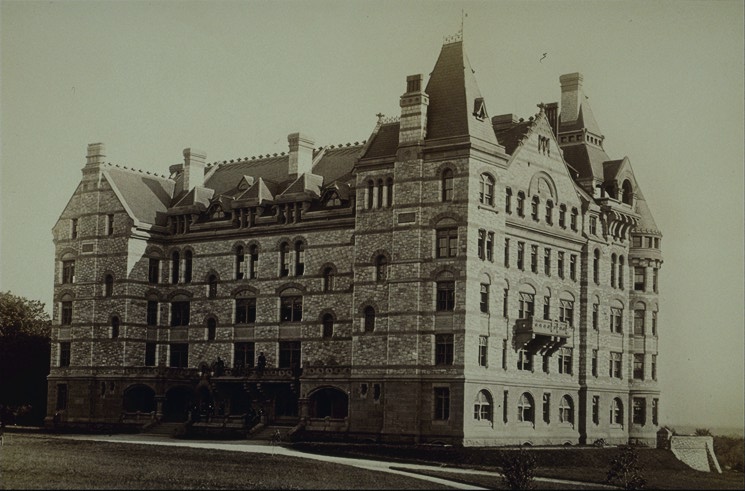
View from northwest (photo circa 1881)
Princeton University. Property of the Trustees of Princeton University.
Source: Princeton University Archives, Mudd Library, Grounds & Buildings, Box 69
Princeton University. Property of the Trustees of Princeton University.
Source: Princeton University Archives, Mudd Library, Grounds & Buildings, Box 69

Despite the construction of Reunion Hall in 1870, the College of New Jersey continued to experience an acute shortage of dormitory rooms. Enrollment rose steadily throughout the 1870s, and President McCosh eventually constructed five more dormitories. The most important and architecturally interesting of these structures was Witherspoon Hall, commissioned in 1875 and occupied two years later.
Designed by William A. Potter and Robert H. Robertson, Witherspoon was another in the series of High Victorian Gothic buildings at Princeton that included the John C. Green School of Science and Chancellor Green Library. More significant than choice of style, however, was Witherspoon's placement on the far western side of the campus and the unparalleled luxury of its accommodations. Both of these factors reflected dramatic changes in the College and its perception of itself.
Witherspoon's location, to the west of Clio and to the south of the Bonner-Marquand Gymnasium, was influenced by the advent of the railroad. For more than a century, Nassau Street had been the main thoroughfare and access route to Princeton. But the construction of a new railroad station, built in the 1870s at the base of what is now Blair Arch, changed all that. The primary entrance to the campus immediately shifted from Nassau Street to the west side of the campus.