
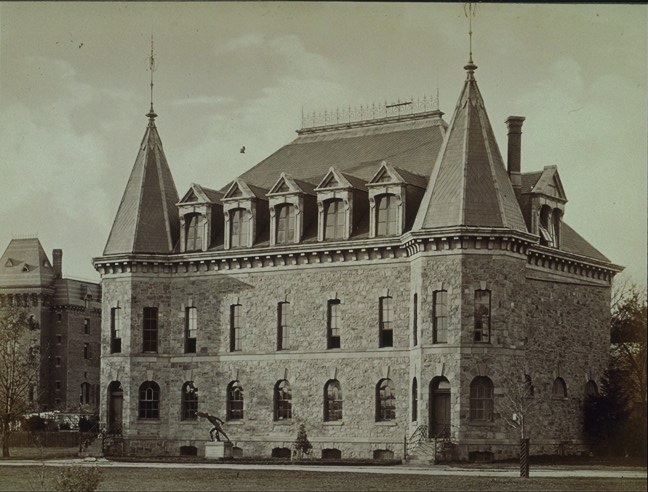
Bonner-Marquand Gymnasium: View from southeast with University Hotel at left
In his inaugural address, President McCosh endeared himself to his new students by strongly endorsing collegiate athletics. It was a shrewd move. Inadequate athletic facilities and lack of support from the administration had long frustrated the student body. Making matters worse, the College's makeshift gymnasium -- little more than a barn -- had been intentionally burned down in 1865 after a tramp with smallpox reportedly slept there one night; it had never been replaced.
McCosh's attentiveness to athletics illustrated his deep concern for the quality of life of the students in his charge. When McCosh arrived at Princeton, living conditions at the College of New Jersey were spartan. Students living in East and West College relied on fireplaces for heat and kerosene lamps for light. Neither of these dormitories nor Nassau Hall had water-closets. Even with the reduced enrollment, many of the students, even freshmen, had to live and dine in town.
McCosh found this situation unacceptable. He envisaged Princeton as becoming a residential university along the lines of what he had known in Scotland and Ireland. To achieve that vision -- and to attract more students -- the College needed larger and better facilities.
Princeton University. Property of the Trustees of Princeton University.
Source: Princeton University Archives, Mudd Library, Grounds & Buildings, Box 38

Consequently, the first two structures he built in Princeton were the Bonner-Marquand Gymnasium , which opened in 1869,