
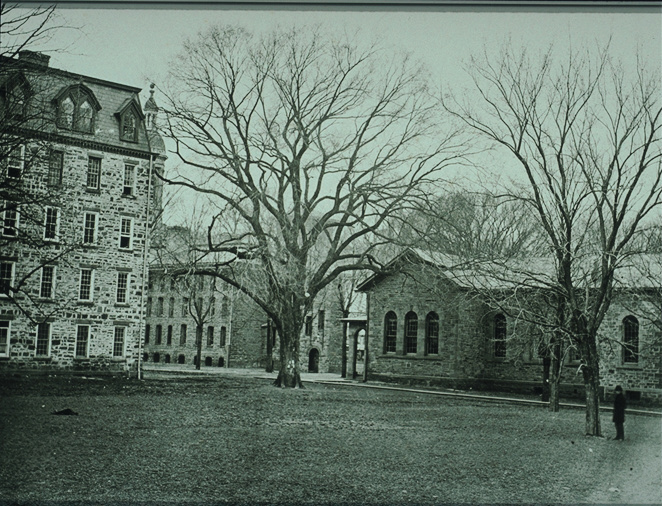
The Old Chapel, viewed from the southeast, with Bulletin Elm and East College at left (1870's photo)
Princeton University. Property of the Trustees of Princeton University.
Source: Historical Society of Princeton
Princeton University. Property of the Trustees of Princeton University.
Source: Historical Society of Princeton

As much as he was committed to improving the minds and bodies of the youths entrusted to his care, James McCosh was foremost a religious man: a minister of the Gospel who viewed the world as a struggle between the forces of religion and immorality. And although today he is remembered primarily for reforming the College's academic program, he had an equally profound impact on the spiritual life of the campus.
During his tenure at Princeton, McCosh helped spark a religious revival among the students unlike any other in the College's long history. He invited revivalist speakers such as Dwight Moody and Ira Sankey to speak at Princeton, supported the growth of student religious organizations (notably the Philadelphian Society), and vigorously rooted out the underground "secret societies" that he believed promoted atheism and alcohol. To accommodate this upsurge in religious activity, McCosh built two new buildings.
When McCosh assumed office in 1868, however, the great wave of revivals was still a few years off. Instead, his first order of business on this front was to extend the nave of the Chapel. This structure, which had been designed by John Notman and built in 1846, was barely large enough to hold the student body during the daily required chapel services. McCosh was thinking ahead of higher enrollments, and in 1870 he added three bays to the nave as a stopgap measure.