
View from northwest (photo 1880's?)
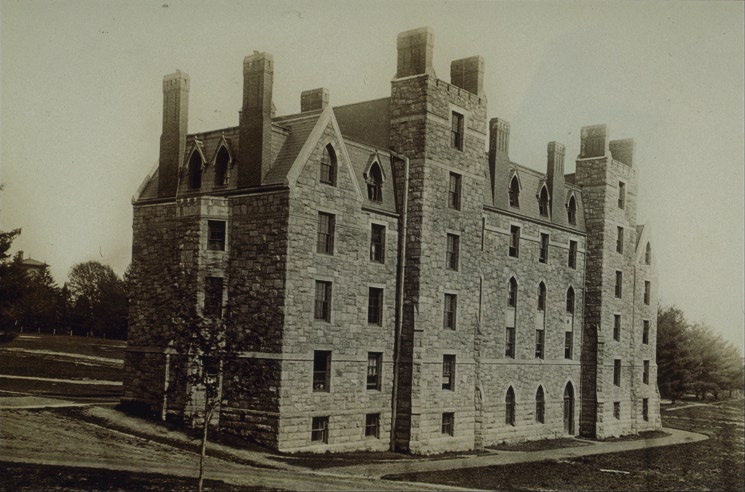
Princeton University. Property of the Trustees of Princeton University.
Source: Princeton University Archives, Mudd Library, Grounds & Buildings, SP3
Princeton University. Property of the Trustees of Princeton University.
Source: Princeton University Archives, Mudd Library, Grounds & Buildings, SP3

When Witherspoon Hall was completed in 1877, it was the most luxurious and desirable dormitory on campus, designed to cater to Princeton's increasingly affluent student body. Edwards Hall, built two years later, was designed with precisely the opposite purpose in mind: providing spartan accommodations for the College's poorest students.
The need for "the poor man's dormitory" -- as Edwards was called -- arose from Princeton's practice of charging different rents for different dormitory rooms (a system that lasted well into the 1960s). Richer students could afford the luxurious new suites in Witherspoon, but not the men who were on scholarships. Concerned lest the College become a haven for the wealthy, President McCosh resolved to build a new, low-rent dormitory.
Reflecting the need to economize, the College secured a design from Edward D. Lindsey, the Curator of Buildings and Grounds and professor of architecture. As requested, he produced a very simple plan for a four-story dormitory composed entirely of single rooms. Financed by a donation from the estate of John C. Green, the new dormitory cost $30,000 --less than a third of what Witherspoon cost. It was located on the swampy ground behind Clio and Witherspoon. The new structure was named after Jonathan Edwards, the third president of the College, and accepted its first residents in 1880.