
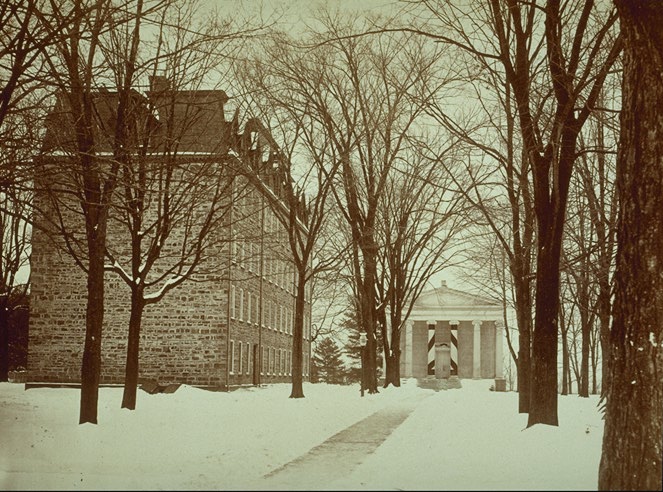
Distant view of Whig Hall facade from north, with East College at left (photo c.1886)
Princeton University. Property of the Trustees of Princeton University.
Source: Princeton University Archives, Mudd Library, Grounds & Buildings, Box 59
Princeton University. Property of the Trustees of Princeton University.
Source: Princeton University Archives, Mudd Library, Grounds & Buildings, Box 59

...seem somewhat out of place amidst the Collegiate Gothic of the Princeton campus. But in the late 1830s, when these structures were first erected, they represented the height of architectural fashion. The reference to classical Greek structures was an appropriate gesture by societies that existed to promote "democratic" debate.
Who precisely designed the Halls remains murky. Some believe that the Societies, with Clio following Whig's lead, commissioned the prominent Philadelphia architect John Haviland to design their new Halls. Haviland is best known for designing the monumental "Tombs" prison in New York. Others believe that the local builder/architect Charles Steadman produced the design. Steadman's work continues to be visible in the Princeton area, particularly on Alexander Road.