Princeton University. Property of the Trustees of Princeton University.
But the other dorm dating from this period, Spelman Hall, was much more stylistically daring. Designed by I.M. Pei, the stark white and glass triangles of Spelman (commissioned in 1971) contrasted sharply with the Collegiate Gothic of neighboring Pyne Hall and Dillon Gymnasium.
Spelman also represents a significant cultural departure for Princeton. Indicative of the times, it allocated space for married student housing and the inclusion of kitchenettes in each suite was symbolic of the increasing number of "independents." (Eating club membership bottomed out in this period.) The implicit emphasis on self-reliance and suite living marked a far cry from the idea of the communal residential university, as conceived by Wilson and West.
Spelman was also the last of the four dozen buildings conceived, designed, built, or acquired during the Goheen presidency, and it serves as a remarkable structure marking the end of a decade of explosive growth. The onset of harder economic times in the 1970s and early 1980s drastically curtailed the building program of Goheen's successor, William Bowen *58. Furthermore, as Bowen discovered, Princeton's now-enormous physical plant required constant and expensive maintenance. And the University had only just begun to cope with the physical plant problems attendant with the decision to admit women.
More than 10 years passed before the beginning of another fundraising drive, "The Campaign for Princeton", which enabled the University to upgrade its facilities on a meaningful scale. But this time was not idly spent. Under Bowen's guidance, in the 1970s, the University grappled with several core questions about student life and the University's mission that trace back to the turn of the century. With the growth of the campus, these issues had become more pressing. The recommendations of the group assigned the task of sorting it all out, the Committee on Undergraduate Residential Life, or CURL, are still having a major impact on Princeton's architectural landscape today.

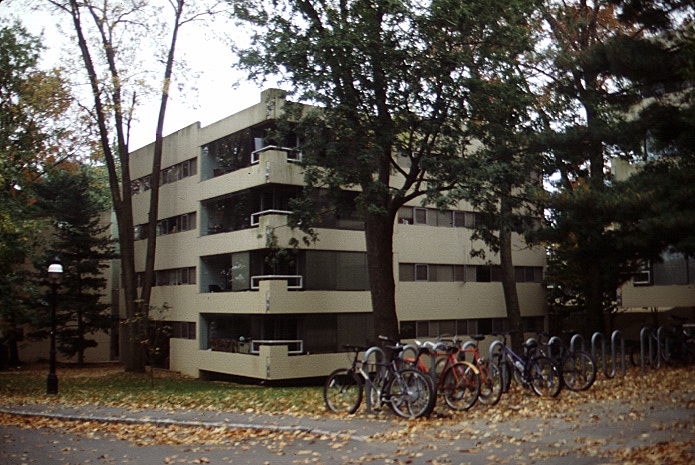

But the other dorm dating from this period, Spelman Hall, was much more stylistically daring. Designed by I.M. Pei, the stark white and glass triangles of Spelman (commissioned in 1971) contrasted sharply with the Collegiate Gothic of neighboring Pyne Hall and Dillon Gymnasium.
Spelman also represents a significant cultural departure for Princeton. Indicative of the times, it allocated space for married student housing and the inclusion of kitchenettes in each suite was symbolic of the increasing number of "independents." (Eating club membership bottomed out in this period.) The implicit emphasis on self-reliance and suite living marked a far cry from the idea of the communal residential university, as conceived by Wilson and West.
Spelman was also the last of the four dozen buildings conceived, designed, built, or acquired during the Goheen presidency, and it serves as a remarkable structure marking the end of a decade of explosive growth. The onset of harder economic times in the 1970s and early 1980s drastically curtailed the building program of Goheen's successor, William Bowen *58. Furthermore, as Bowen discovered, Princeton's now-enormous physical plant required constant and expensive maintenance. And the University had only just begun to cope with the physical plant problems attendant with the decision to admit women.
More than 10 years passed before the beginning of another fundraising drive, "The Campaign for Princeton", which enabled the University to upgrade its facilities on a meaningful scale. But this time was not idly spent. Under Bowen's guidance, in the 1970s, the University grappled with several core questions about student life and the University's mission that trace back to the turn of the century. With the growth of the campus, these issues had become more pressing. The recommendations of the group assigned the task of sorting it all out, the Committee on Undergraduate Residential Life, or CURL, are still having a major impact on Princeton's architectural landscape today.