
Woodcut of Nassau Hall (1786)
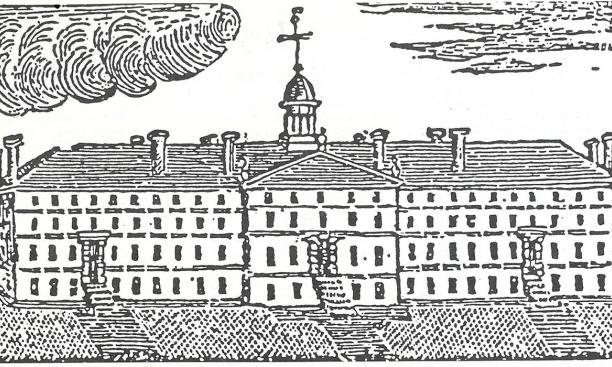
Princeton University. Property of the Trustees of Princeton University.
Source: Princeton Historical Society, Princeton Alumni Weekly Archives
Princeton University. Property of the Trustees of Princeton University.
Source: Princeton Historical Society, Princeton Alumni Weekly Archives

At the end of the war, Nassau Hall was in a sorry state. But by July 1783, parts of the building -- including the Prayer Hall and library -- had been sufficiently repaired to house, for four months, the Continental Congress, which brought such men as Washington, Adams, Jefferson, and the other statesmen of the age to Princeton.
But the famous company must have been of little solace to the beleaguered students of the College. With Witherspoon distracted by affairs of state and the College facilities badly damaged, student life in the early years of the Republic must have been bleak indeed.
Then as now, the food was a sore point. In 1782, for example, a young man named Peter Elmendorf wrote in his diary about the students' bill of fare: "We eat rye bread, half dough, and as black as it possibly can be, and oniony butter, and some times dry bread and thick coffee for breakfast, a little milk or cyder and bread, and sometimes meagre chocolate for supper, very indifferent dinners, such as lean tough boiled fresh beef with dry potatoes."
For students, the slow rebuilding from wartime damage must have been a continuing source of frustration. The College was still applying for war reparations from Congress as late as 1801.
Traveling through Princeton in 1798, an Englishman named Isaac Weld Jr. recorded his impressions of the post-Revolutionary Nassau Hall:
Today, of course, the University takes great pride in Princeton's role in the Revolution as a battleground. One of the legendary ghosts on the campus is that of a dying British soldier, who has been reportedly sighted in the basement of Holder Hall on several occasions; other Revolutionary ghosts purportedly haunt Nassau Hall itself. Generations of Orange Key guides have shown visitors the spot on the south wall of Nassau Hall where one of Hamilton's cannonballs struck the building. To this day, groundskeepers carefully trim a small circle in the ivy in that spot.