
Burnt remains of Nassau Hall
Princeton University. Property of the Trustees of Princeton University.
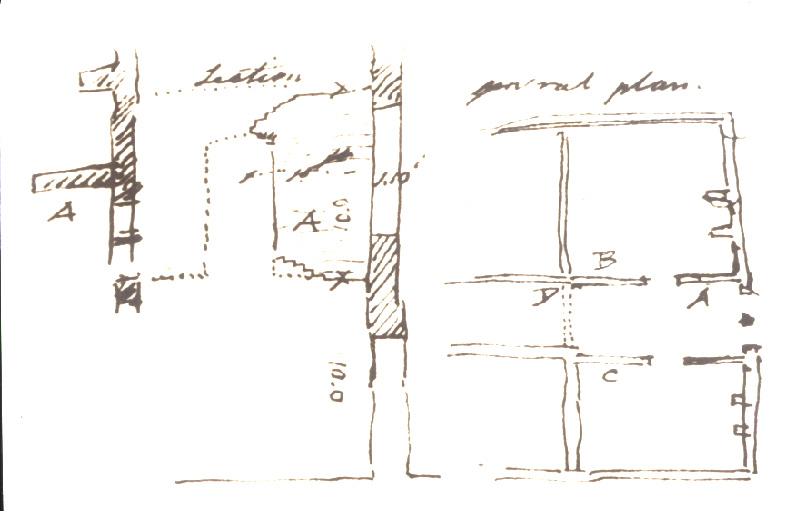
Section and plan of burnt remains of Nassau Hall sketched by Benjamin Latrobe (1802-03) Source: Princeton University Archives, Mudd Library, Nassau Hall Iconography

At one o'clock on the windy afternoon of 6 March 1802, Nassau Hall was swept by a devastating fire .
According to the Trenton True American, "In two hours from the time it was discovered on fire the whole building, walls excepted, was reduced to ashes."
An investigation by the Trustees concluded that the building had been "intentionally set on fire." President Samuel Stanhope Smith , who was inclined to believe the worst about undergraduates, believed the fire a product of vice and impiety. George Strawbridge 1802 (later a supreme court judge in Louisiana) made an independent investigation and concluded that no student was in any way guilty; he thought sooty chimneys probably responsible.
Yet all agreed that the College had suffered grievously in the fire. Meeting in emergency session ten days after the blaze, the Trustees learned that the library had been almost totally destroyed, along with many of the College's portraits and the belongings of the students. The lone bright spot was the survival of most of the College's "Philosophical and Chemical" apparatus.
Physical damage aside, to watch Nassau Hall burn must have been a crushing blow to President Smith and other supporters of the College. Nassau Hall had begun to heal from the scars of the Revolution, and now the College would have to start from scratch once more.
The Trustees nonetheless immediately resolved to rebuild. They delegated the college treasurer, Enos Kelsey, to spearhead the reconstruction. Not surprisingly, the renovation program that the Trustees authorized had as its chief goal to reduce the risk of fire in the future:
"The Entries [are] to be laid with brick or Tiles instead of Boards. The stairs [are] to be formed of Iron, stone, or other incombustible materials...The Place of the former [Prayer] Hall to be fixed so as to serve a Library and the deposit of the philosophical apparatus and a place for the reading of daily prayers, as formerly. [The roof will] be covered with Tin or other incombustible material instead of shingles."