Princeton University. Property of the Trustees of Princeton University.
Source: Unknown
After the completion of East and West colleges, the College's institutional energy was spent. The next building to appear on the rear campus was more the result of the initiative of one man -- Joseph Henry -- than the product of a coherent building campaign.
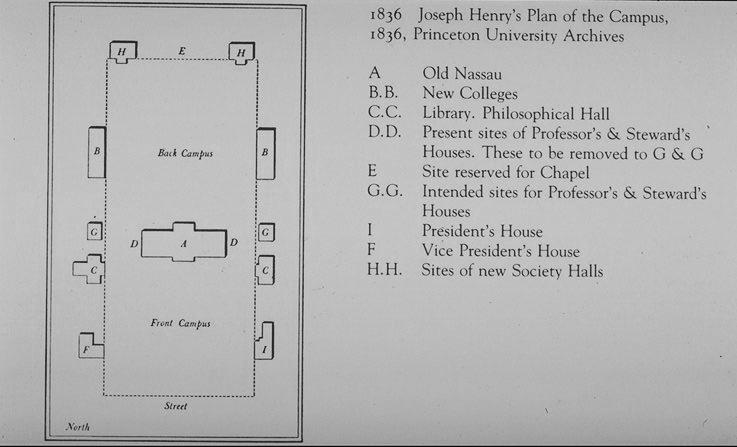
In September 1836, Henry submitted to the Trustees a plan of the existing campus structures and indicated areas for future growth. The plan codified the idea of a symmetrical campus and incorporated several structures that were either under construction -- West College -- or as yet unbuilt, including new halls for the Whig and Cliosophic Societies. Also part of Henry's scheme were two new houses for professors, on either side of Nassau Hall; Henry himself would live in the one to the west.
Finishing off the rear campus, between the halls of Whig and Clio, Henry reserved a site for a new chapel. This central location would provide a symbolic religious complement to the secular splendor of Nassau Hall.
When Henry drew up his plan, though, the site served a more prosaic function. It was the College privy.
One would be mistaken to attribute too much significance to the Henry plan, however. Although it certainly represented the first formal attempt to diagram the campus and identify locations for future construction -- and also clarified the idea that the College had two main areas centered on Nassau Hall, the front and rear campuses -- to a large degree Henry was simply codifying the results of decisions that had already been made.


After the completion of East and West colleges, the College's institutional energy was spent. The next building to appear on the rear campus was more the result of the initiative of one man -- Joseph Henry -- than the product of a coherent building campaign.
In September 1836, Henry submitted to the Trustees a plan of the existing campus structures and indicated areas for future growth. The plan codified the idea of a symmetrical campus and incorporated several structures that were either under construction -- West College -- or as yet unbuilt, including new halls for the Whig and Cliosophic Societies. Also part of Henry's scheme were two new houses for professors, on either side of Nassau Hall; Henry himself would live in the one to the west.
Finishing off the rear campus, between the halls of Whig and Clio, Henry reserved a site for a new chapel. This central location would provide a symbolic religious complement to the secular splendor of Nassau Hall.
When Henry drew up his plan, though, the site served a more prosaic function. It was the College privy.
One would be mistaken to attribute too much significance to the Henry plan, however. Although it certainly represented the first formal attempt to diagram the campus and identify locations for future construction -- and also clarified the idea that the College had two main areas centered on Nassau Hall, the front and rear campuses -- to a large degree Henry was simply codifying the results of decisions that had already been made.