
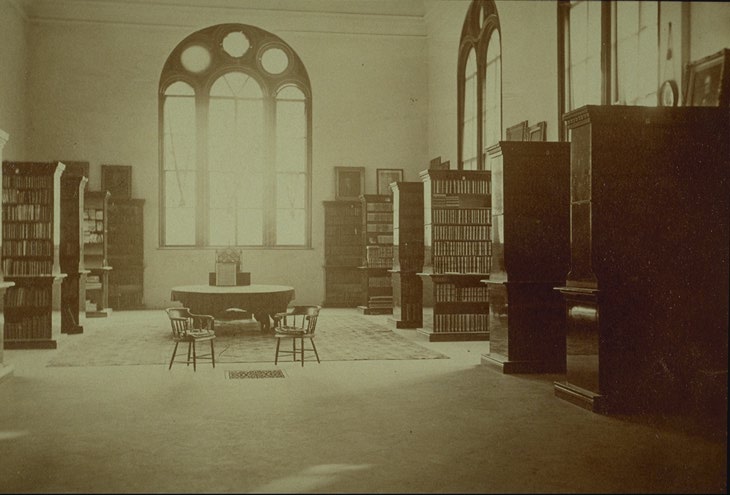
Interior, library in south wing, looking toward window (photo circa 1868)
Princeton University. Property of the Trustees of Princeton University.
Source: Princeton University Archives, Mudd Library, Grounds & Buildings, Box 55
Princeton University. Property of the Trustees of Princeton University.
Source: Princeton University Archives, Mudd Library, Grounds & Buildings, Box 55

This southerly exposure gave the library excellent natural light, and the space was a great improvement over the library's cramped quarters in Geological Hall.
Subsequent critics have heaped much opprobrium on Notman for the liberties he took with Nassau Hall, particularly the towers. But at the time, the Trustees were well satisfied with the transformation of Old North. As the Building Committee reported on 27 June 1860:
"With unfeigned pleasure the Committee report to the Board of Trustees that the work committed to their care is finished. Nassau Hall, burnt in 1854 [sic], has not only been rebuilt, but has been enlarged and greatly improved. It is in every respect a better building than it ever was before: and it is the belief of the Committee that a more substantial and commodious college building is no where to be seen in our country. Its walls are stone and brick, its roof iron and slate; its timbers iron with arches of brick between them all. It contains fifty-four lodging rooms for the accommodation of the students, with ample provision for heating, ventilation,&c. The Library Room is large, beautifully proportioned, and chastely furnished."
In the years immediately following the second great fire, President Maclean was forced to operate the College on a tight belt. Donations to rebuild Nassau Hall were not as forthcoming as they had been in 1802, and for five years Maclean struggled to pay off the College's debt.
This was just a taste of greater struggles to come, however. Matriculating freshmen moving into the newly renovated Nassau Hall in the fall of 1856 could scarcely have imagined that by the time they graduated, the country would be on the brink of the most violent and bloody upheaval in its history.
Doubtless the election of Lincoln and threats of secession weighed heavily on the minds of the Trustees when they met in December 1860, scarcely six months before the Battle of First Manassas. On their agenda were proposals to raise two new structures. The first, the new Cloaca Maxima, would resolve once and for all the nettlesome "backbuilding" issue.