Princeton University. Property of the Trustees of Princeton University.
Source: Unknown
Princeton next turned to the physics and math departments, as strapped for space in Palmer and Jones Halls as their engineering colleagues had been in Green. In 1965, the University sent an open letter to the Princeton community announcing a major new building program for the southeastern corner of the campus around Palmer Stadium. Among the main elements of this program were plans for a 13-story tower for the math department and large attached physics complex.
Undergraduates -- including one group called Students for Architectural Responsibility -- and townspeople objected strenuously to the plans, particularly to the size of the tower -- some 170 feet which was higher than the cupola of Nassau Hall or the vault of the chapel. The University responded that because of the topography of the site, far down Washington Road near Lake Carnegie, Fine Tower would not dominate the skyline.
According to the University, the tower design was also the most effective solution to the academic requirements of the building and the desire to maintain the largest amount of green space as possible. (It was built on the former site of Fitzpatrick Field.) As architect Arthur Keyes '39 wrote, "a complex this size could become a very dull lump without the contrasting vertical element."
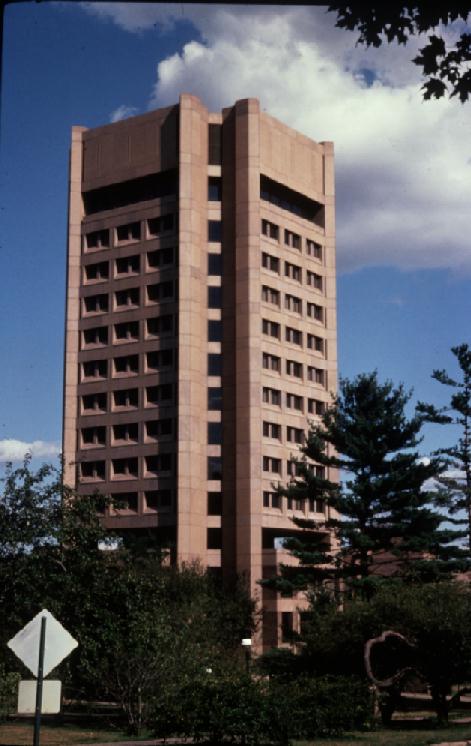
Designed by the firm of Warner, Burns, Toan, and Lunde, Fine Hall is actually two buildings: a 10-story tower that rises from the western end of a longer, three-story base, and is sheathed in plain dark granite, with no exterior ornamentation. Fine Hall, nonetheless, echoes the proportions and visual impact of the earlier Collegiate Gothic towers elsewhere on the campus.


Princeton next turned to the physics and math departments, as strapped for space in Palmer and Jones Halls as their engineering colleagues had been in Green. In 1965, the University sent an open letter to the Princeton community announcing a major new building program for the southeastern corner of the campus around Palmer Stadium. Among the main elements of this program were plans for a 13-story tower for the math department and large attached physics complex.
Undergraduates -- including one group called Students for Architectural Responsibility -- and townspeople objected strenuously to the plans, particularly to the size of the tower -- some 170 feet which was higher than the cupola of Nassau Hall or the vault of the chapel. The University responded that because of the topography of the site, far down Washington Road near Lake Carnegie, Fine Tower would not dominate the skyline.
According to the University, the tower design was also the most effective solution to the academic requirements of the building and the desire to maintain the largest amount of green space as possible. (It was built on the former site of Fitzpatrick Field.) As architect Arthur Keyes '39 wrote, "a complex this size could become a very dull lump without the contrasting vertical element."
Designed by the firm of Warner, Burns, Toan, and Lunde, Fine Hall is actually two buildings: a 10-story tower that rises from the western end of a longer, three-story base, and is sheathed in plain dark granite, with no exterior ornamentation. Fine Hall, nonetheless, echoes the proportions and visual impact of the earlier Collegiate Gothic towers elsewhere on the campus.