
View from southwest before facade reliefs completed
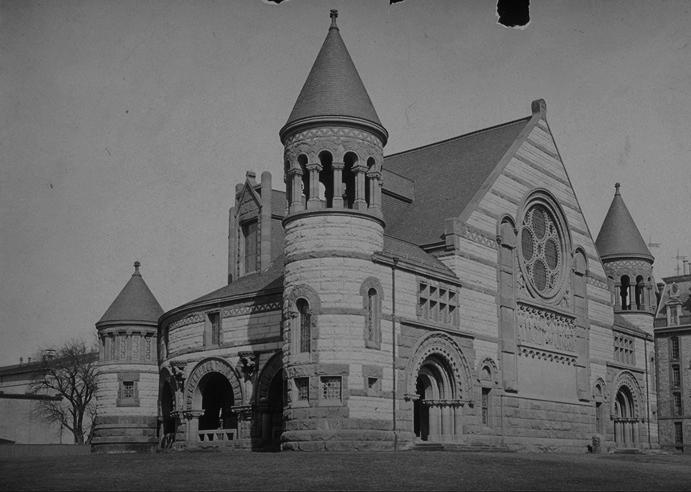
Princeton University. Property of the Trustees of Princeton University.
Source: Princeton University Archives, Mudd Library, Grounds & Buildings, Box 1
Princeton University. Property of the Trustees of Princeton University.
Source: Princeton University Archives, Mudd Library, Grounds & Buildings, Box 1

Alexander Hall holds an undeserved place of scorn in the mythology of Princeton undergraduates. Legend has it that Alexander Hall was designed by a student as his architectural thesis -- and that he received a failing grade for his effort.
Later, the story goes, this same alumnus got his revenge by agreeing to donate a large sum to the University, but only if the gift were used to construct his failed senior thesis project. A great story, but completely apocryphal.
The only grades associated with Alexander Hall were those of the thousands of students whose marks were posted in Alexander at the end of each term -- perhaps the root of undergraduate enmity for the building. Far from being designed by an undergraduate, Alexander Hall represents the culmination of architect William A. Potter's work at Princeton.
Almost the house architect for Princeton during the McCosh years, Potter designed such Princeton landmarks as Chancellor Green Library, the John C. Green School of Science, and, with his partner, Robert H. Robertson, Witherspoon Hall, and the University Hotel. When the Trustees determined, in 1890, that Princeton needed a "convocation" hall that could seat the entire student body, Potter was the logical choice to design it.
A donor was found in Harriet Crocker Alexander, the wife of Charles B. Alexander, class of 1870. The Alexanders and Princeton had deep ties: Archibald Alexander was the first professor of theology at the Princeton Theological Seminary; James Alexander taught at both the College and the Seminary; and Henry Alexander, class of 1840, was a Trustee of the College.