
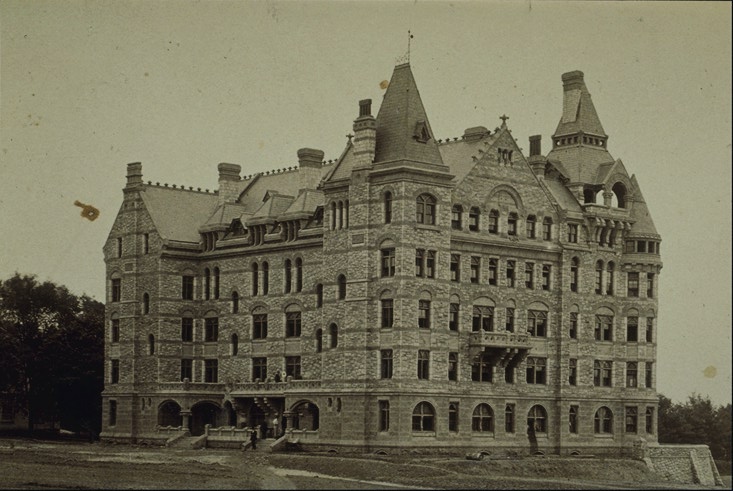
View from northwest (photo circa 1880)
Princeton University. Property of the Trustees of Princeton University.
Source: Princeton University Archives, Mudd Library, Grounds & Buildings, SP7
Princeton University. Property of the Trustees of Princeton University.
Source: Princeton University Archives, Mudd Library, Grounds & Buildings, SP7

Other interesting details included the rounded arches on the entrance porch, spandrels above the windows, and textured panels of stone on the facade. And according to one contemporary account, "It was planned with special reference to the sun's course, the design being to allow every room a chance at the sunshine during some portion of the day."
As originally designed, the interior of Witherspoon was really four separate buildings, each with a separate entryway. At the same time, the distinctive entrance porch on the north side, which connects the east and west wings of the building, unifies the exterior of structure.
Although extremely popular with students at first, Witherspoon fell out of favor once the Collegiate Gothic style dormitories began to be built in the 1890s. Once the most expensive and sought-after accommodations on campus, Witherspoon gradually became one of the least desirable addresses at Princeton. The great western tower, damaged by storms, was removed in the 1940s.
In 1969, the top three floors of the building were condemned as a fire hazard. A year later, the first two floors served as a home for women undergraduates while Brown Hall was renovated. There was talk of tearing down the building, but after an energetic "Save our 'Spoon" campaign by alumni and students, the Trustees decided to renovate it instead. Over the summer of 1974, the University installed a sprinkler system, replaced bathrooms, improved fire egress, and otherwise modernized the old dormitory.