
Firestone Library, as viewed from Pyne
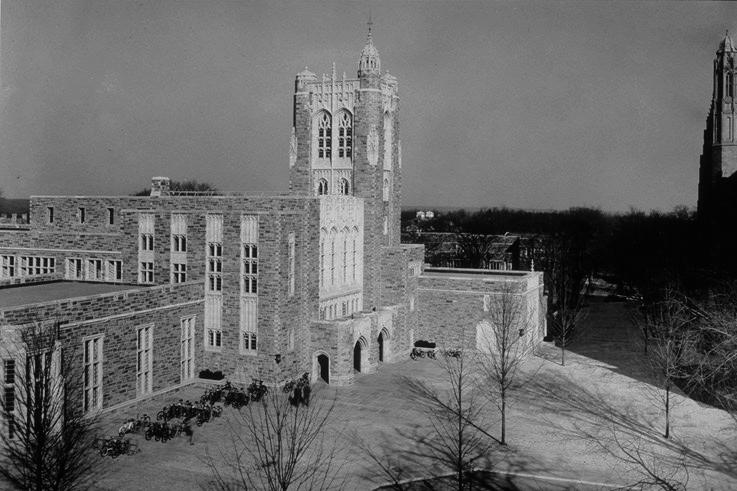
Princeton University. Property of the Trustees of Princeton University.
Source: Princeton University Archives, Mudd Library, Grounds & Buildings, MP44
Princeton University. Property of the Trustees of Princeton University.
Source: Princeton University Archives, Mudd Library, Grounds & Buildings, MP44

Although undergraduates at the time excoriated Firestone as a boring "Gothic cloak" superimposed on a concrete skeleton, it succeeded admirably in the crucial consideration of scale. From the front, Firestone seemed far too small to be a world-famous research library. Only from the air, in fact, can one appreciate how immense this structure really is, especially following major expansions in 1962, 1970, and 1989.
Unlike previous building campaigns, the "Third Century Fund" did not emphasize dormitories. Indeed, the only dormitory erected during the Dodds era -- 1915 -- was more the product of the labor of the donor class than of the university administration. Anticipating a surge in enrollment following the war, the Class of 1915 began soliciting contributions during the war for a new dormitory.
Shortages of materials and manpower pushed back construction until October 1948. Even then, the approved design was a far cry from the lavish dormitories of the 1920s: brick instead of stone, largely unornamented, towerless, and regular in its dimensions. As architect Aymar Embury wrote, "Because of high prices [of labor] and widespread demand for building materials," money cannot be spent on purely decorative features."